
The score tells you very little
You'll see it immediately — a big percentage in a circle, red if you failed, green if you passed. Your brain will fixate on it. That's natural. It's also the least useful number on the page.
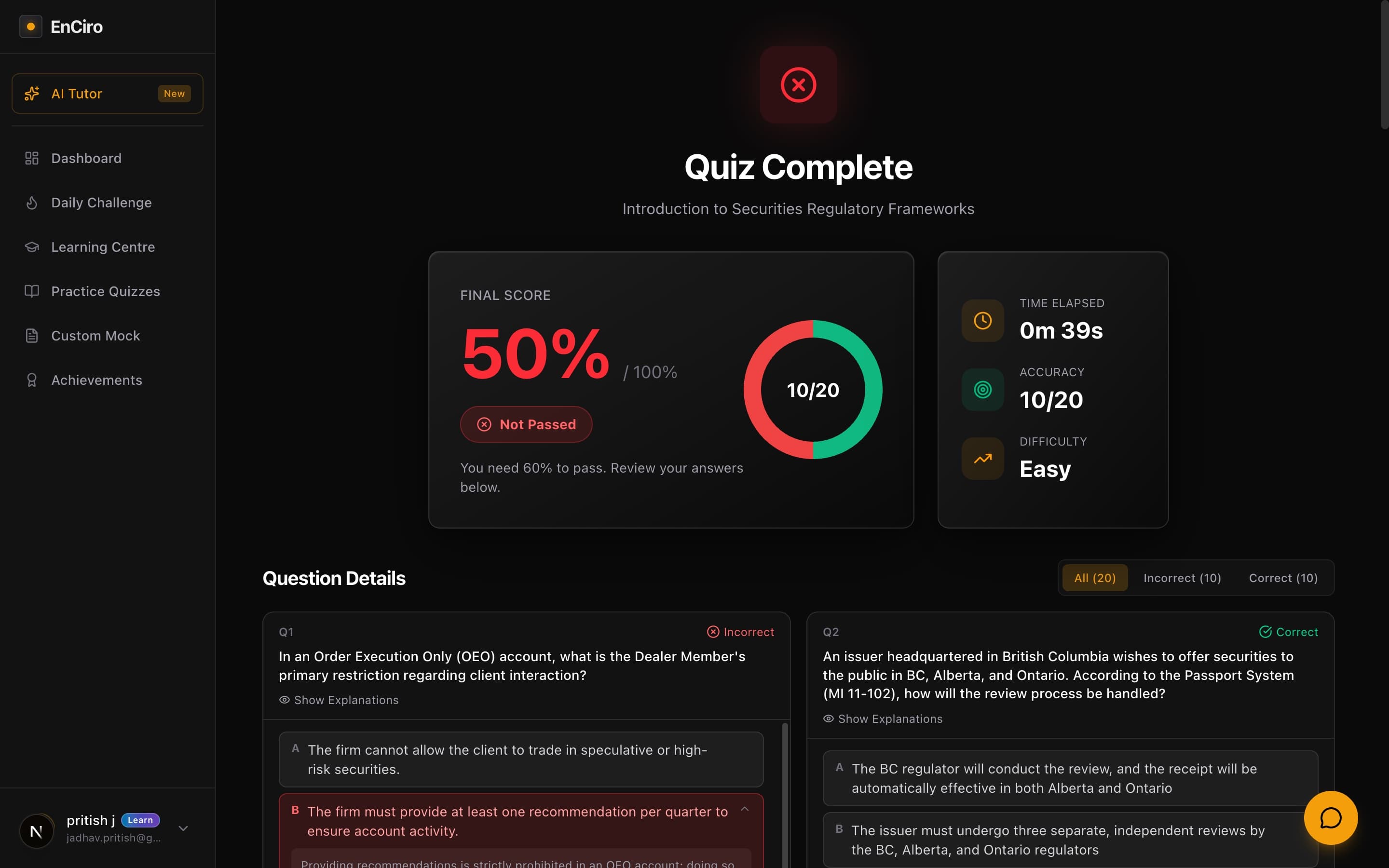
The top section shows your final score, time elapsed, and difficulty level. The pass threshold is 60%, matching the real CIRE. If you're consistently between 50-60%, a few corrected misconceptions could push you over. Below 40%, go back to the Learning Centre readings before taking more quizzes.
But the real page starts below the score: Question Details.
Why we explain every option
Most study tools tell you whether you got a question right or wrong. Some show the correct answer. Almost none tell you why each wrong option is wrong. We do — for every question, every option. This is deliberate.
The CIRE is designed by assessment professionals. The wrong options aren't random nonsense — they're distractors. Each one is carefully written to sound plausible to a candidate with a specific gap in understanding.
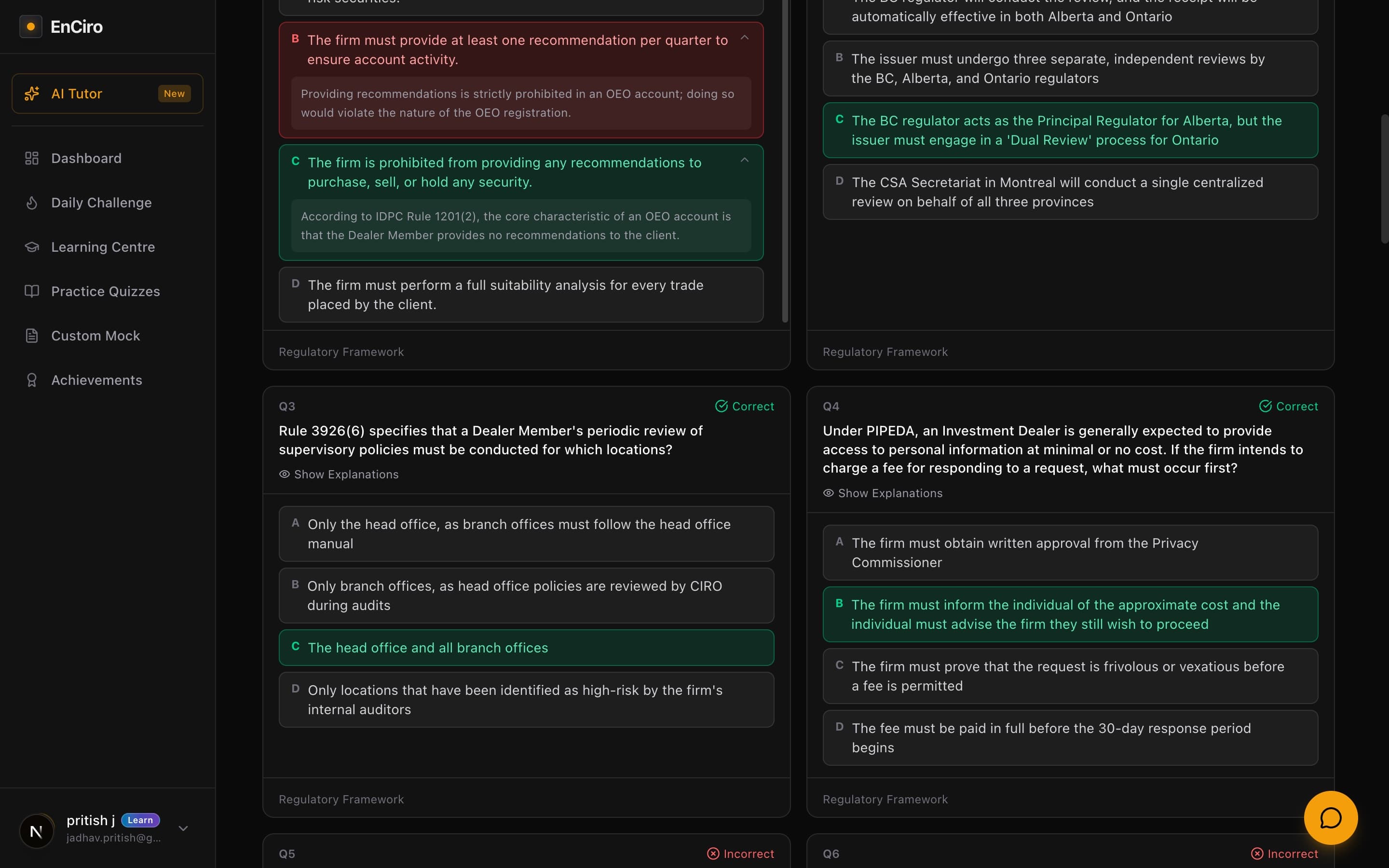
If you learn that IDPC Rule 1202(2) doesn't prohibit all recommendations in OEO accounts — it just defines the nature of the account relationship — you won't fall for any question that tries to trick you with that misconception, no matter how it's worded.
Knowing why the right answer is right teaches you one fact. Knowing why the close-but-wrong answers are wrong teaches you the boundaries of that fact — where it applies, where it doesn't, and what the exam will use to test whether you know the difference.
The distractors are the curriculum
On the real CIRE, the difference between passing and failing usually comes down to 10-15 questions. Those aren't the ones with obviously wrong options — they're the ones where two or three options sound right. If you've practised identifying distractors and understanding why they're wrong, those are the questions you'll get right. That's the margin.
How to read your results
Hit the Incorrect tab first
The results page has three tabs: All, Incorrect, and Correct. Go straight to Incorrect. For every question you got wrong, click Show Explanation and read the explanations for all four options — not just the one you picked and the correct answer.
Ask yourself: why did the distractor fool me? Was it a vocabulary confusion (appropriateness vs. suitability)? A rule I haven't studied? A scenario where I applied the right concept to the wrong context? Naming the type of mistake is the first step to not making it again.
Then check the ones you got right
Sometimes you picked the correct answer for the wrong reason — a vague association, process of elimination, or a lucky guess. If you read the explanation and think "oh, that's why it's right" — that question was a guess. Study that concept before the exam exposes it.
Spot patterns across quizzes
After three or four quizzes, your mistakes will start clustering. Maybe you consistently fall for distractors about conflict of interest disclosure. Maybe you know the definitions cold but struggle when the question asks you to apply a rule to a specific client situation. These clusters tell you exactly which Learning Centre readings to revisit and which flashcards to drill.
Reattempting quizzes
Every quiz lives in your quiz history. You can retake any of them, and your previous score is preserved for comparison.
Taking the same quiz two weeks later — after studying the material in between — gives you something no new quiz can: a direct measurement of whether you've closed the gaps. Scoring 45% on a KYC quiz, going back to the Learning Centre, drilling the flashcards, and coming back to score 75% — that's evidence that you now recognize the traps you used to fall into.
The instinct is to always take new quizzes. Resist it. Reattempts are where you prove to yourself that the work is paying off.
Every attempt feeds your analytics
Every quiz — including reattempts — feeds your dashboard analytics. Score trends, element breakdowns, difficulty performance. The more data you generate, the more precisely your analytics can pinpoint where to focus next.
The results page is the study tool
Most candidates treat results as a scorecard — check the number, move on. The ones who pass treat it as the most important part of the entire quiz experience. The questions tested you. The results page teaches you.
Spend as much time on the results page as you spent taking the quiz. That's not a suggestion — it's the single most efficient thing you can do with your study time.