
Every chart on your dashboard is a decision
Most study apps show you a score and call it a day. EnCiro gives you six charts across three tabs — Element Analytics, Difficulty Analytics, and Time Analytics — each designed to answer a specific question about your prep. The trick is knowing which chart to look at, what the shape is telling you, and what to do about it.
This guide covers all three deep-dive tabs. If you haven't read the dashboard overview yet, start there.
Element Analytics
This tab answers one question: where should you spend your next study session?
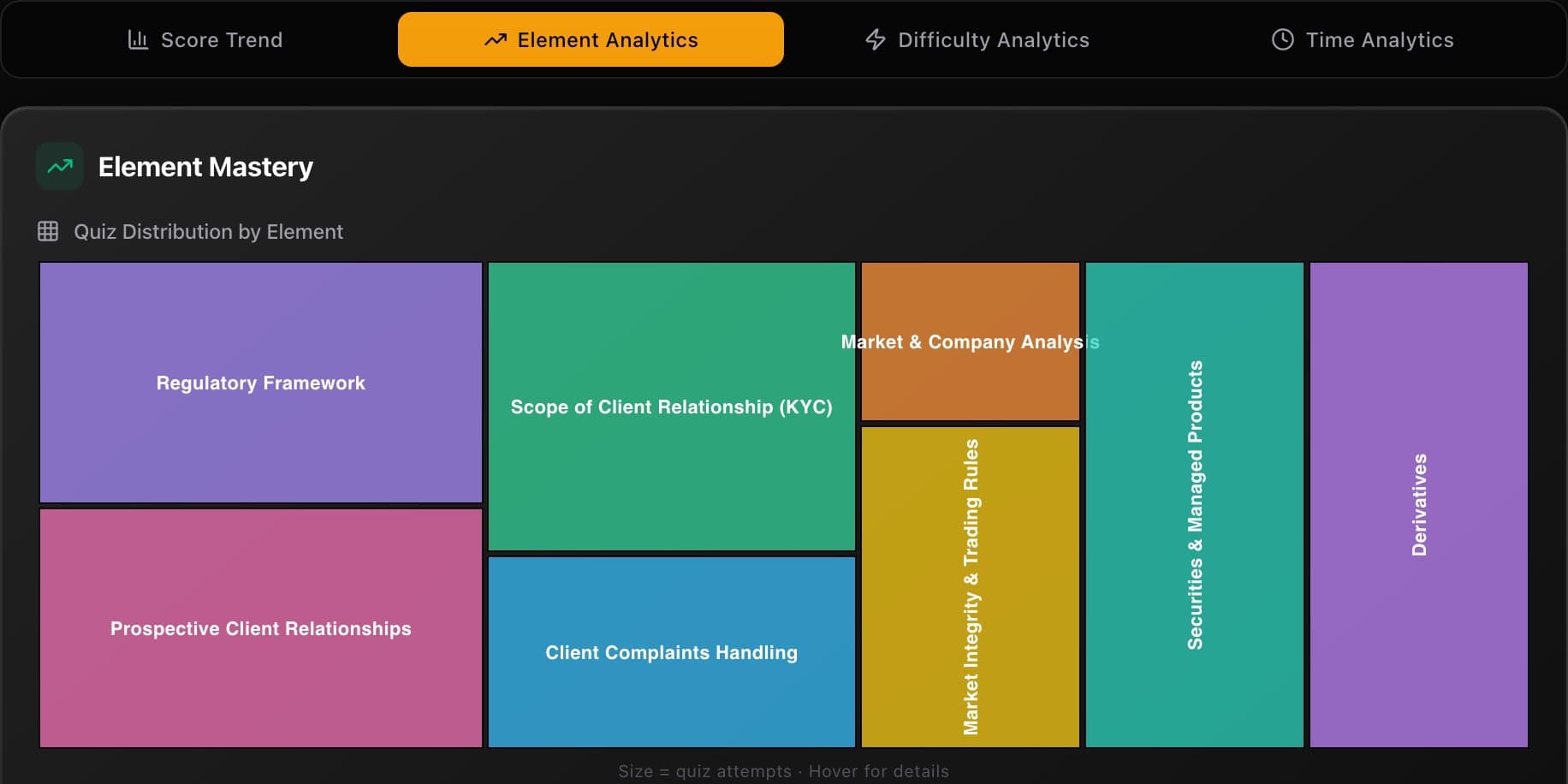
Quiz Distribution treemap
Each rectangle represents one CIRE element. The size tells you how many quiz attempts you've put into that element — bigger rectangle, more attempts. The colour distinguishes elements at a glance.
Three patterns matter here:
- Big rectangle, low score — You've practised this element a lot and it still isn't clicking. Grinding more of the same won't help. Switch tactics: use the AI Tutor to work through your weak spots, or go back to the Learning Centre readings for that element.
- Big rectangle, high score — You're solid. Stop spending time here. Every hour on an element you already own is an hour stolen from one you don't.
- Tiny rectangle — This is a blind spot. In the screenshot above, Derivatives is the smallest rectangle. If the exam covers it (it does), you need more attempts there. Small rectangles hide nasty surprises on exam day.
Your action: Hover over each rectangle to see your average score. Identify the two elements where you have the worst combination of size and score — those are your immediate priorities.
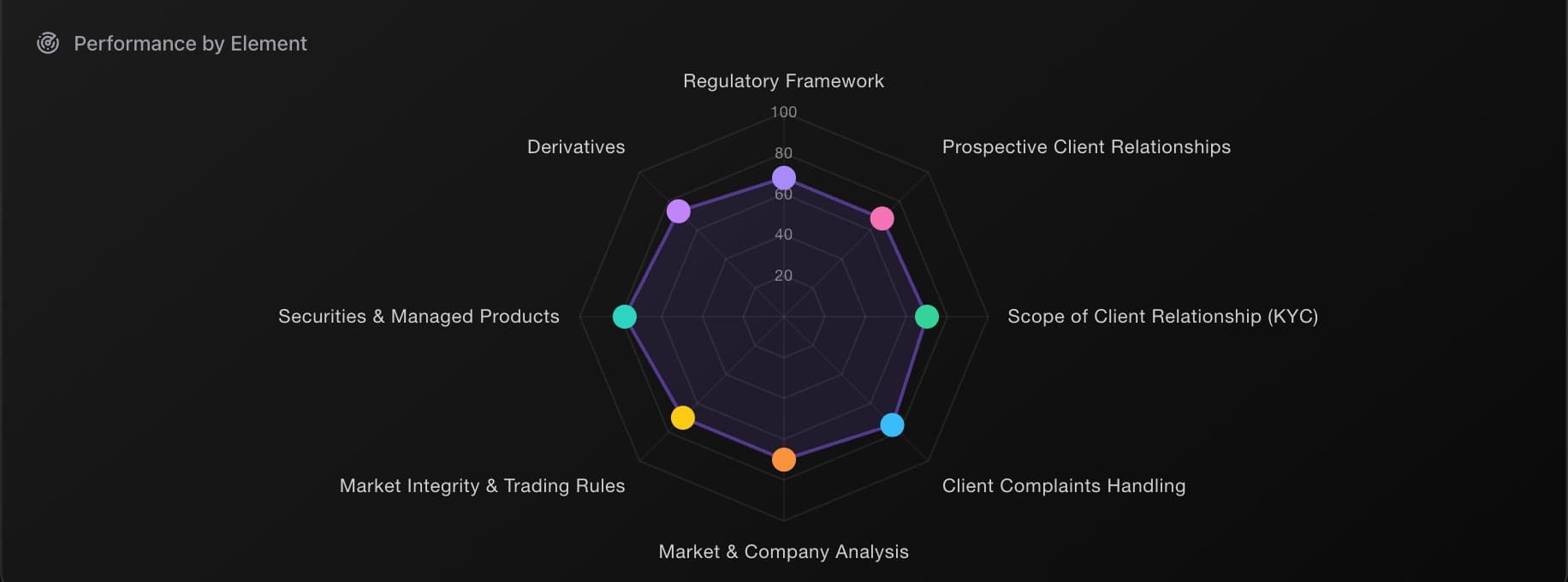
Performance radar chart
The radar plots your average score for each of the 8 CIRE elements on a spider-web diagram. A perfectly balanced candidate would see a circle. You won't see a circle — nobody does — and that's the point.
The dents are your roadmap. Every inward dent is an element pulling your overall average down. In the screenshot above, Market & Company Analysis and Prospective Client Relationships are the deepest dents — those should be your next two weeks of focused practice.
The high points matter too. Regulatory Framework and Derivatives are pushing outward, which means those scores are strong. Don't waste time there unless you're polishing for a perfect score.
Your action: Pick the two deepest dents. Go to Custom Mock Exams and build mocks that target those specific elements. Take 3-4 targeted quizzes, then come back and check if the dents are filling in.
Fewer than 3 elements?
If you've only practised 2 elements so far, the radar falls back to a bar chart — you need at least 3 data points for the spider-web to work. Keep taking quizzes across different elements and it'll appear.
Difficulty Analytics
This tab answers: are you studying at the right difficulty level, and how consistent are you?
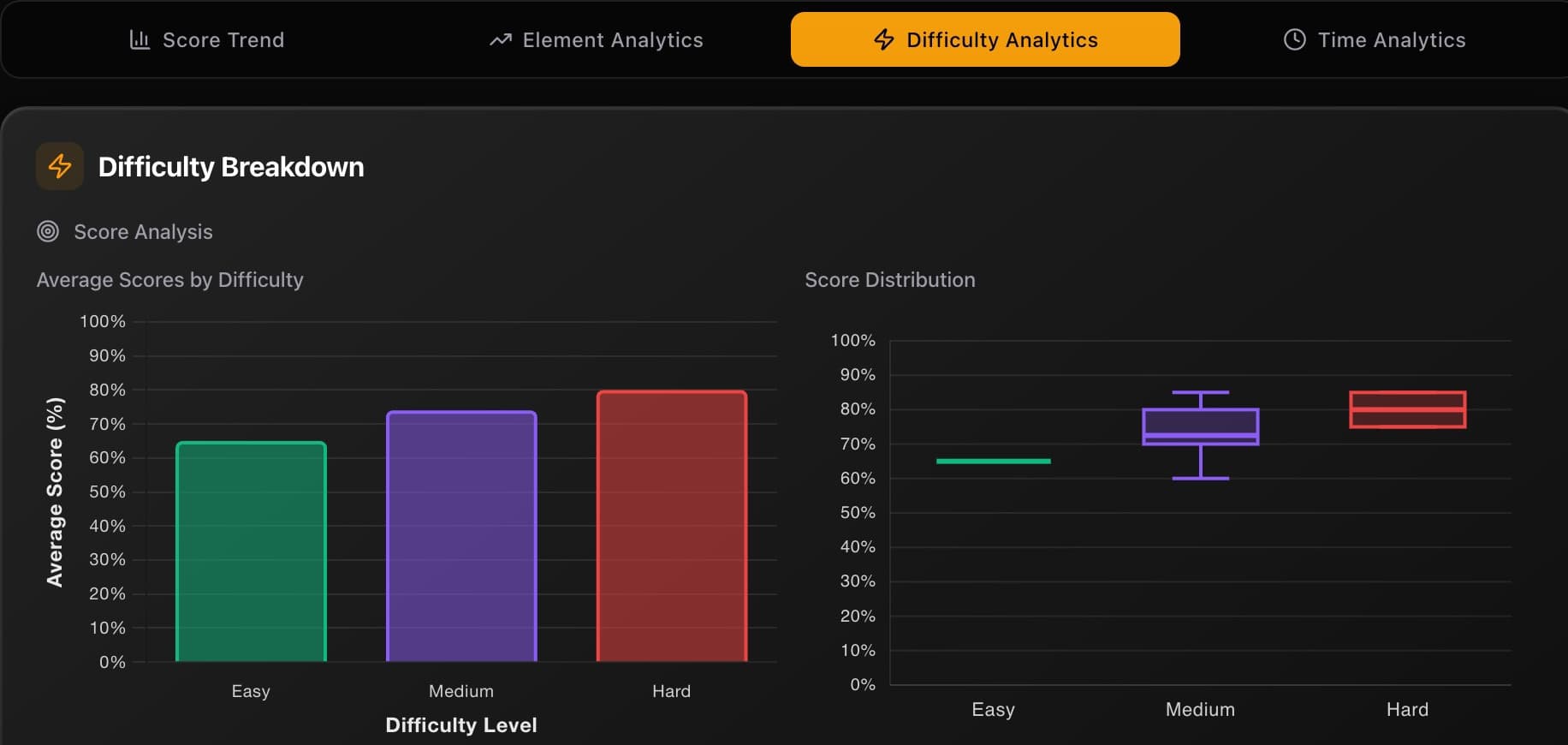
Average Scores bar chart
Three colour-coded bars — one each for Easy, Medium, and Hard — showing your average score at each difficulty level.
The interesting insight is in the pattern, not the individual numbers. Look at the screenshot: Easy sits around 65%, Medium around 72%, and Hard around 78%. That's counterintuitive — scoring higher on hard questions than easy ones. If you see this pattern, it usually means one of two things:
- Careless mistakes on easy questions. You're reading too fast because you assume it's simple, missing key words like "except" or "not." The fix: slow down on easy quizzes and read every option before selecting.
- You're more focused on hard questions. You bring your full attention to hard quizzes but coast on easy ones. The fix is the same — treat every question like it counts, because on exam day, they all do.
The opposite pattern — Easy at 90%, Hard at 45% — means something different. You know the definitions but can't apply them to scenarios. The fix: more case-based practice at higher difficulties.
Score Distribution box plots
This is the chart most people skip. It's the most useful one on this tab.
Each box plot shows the spread of your scores at a given difficulty:
- The box — the middle 50% of your scores (25th to 75th percentile)
- The line inside the box — your median score
- The whiskers — the full range, excluding outliers
- Dots outside the whiskers — outlier scores (unusually high or low attempts)
What you're looking for is box width. A narrow box means your scores are consistent — you perform roughly the same every time. A wide box means you're volatile — nailing some quizzes and bombing others at the same difficulty.
In the screenshot, the Easy box is very narrow (consistent), Medium has a wider range with a whisker dropping below 65%, and Hard is narrow and high. That Medium volatility is worth investigating. Which topics within Medium difficulty are causing the swings? Hover over the box to see exact Q1, median, Q3, min, and max values.
Your action: If any box plot is wide, filter your quiz history by that difficulty level and look for the topics where you scored lowest. Those specific topics — not the difficulty level as a whole — are what need work.

Attempt Distribution donut
The donut shows how many quizzes you've taken at each difficulty. The number in the centre is your total attempts (20 in this case). Medium is the largest slice, with Hard and Easy splitting the rest.
This chart is a reality check. If you're spending 80% of your time on Easy quizzes, you're not preparing for the exam — you're building false confidence. If you're grinding Hard quizzes while your Easy scores are below 70%, you're skipping steps and making things harder than they need to be.
The difficulty ladder
The progression that works: get your Easy accuracy above 85%, then shift your attempts toward Medium. Once Medium is consistently above 75%, start mixing in Hard. This isn't about ego — it's about building the foundational knowledge that hard questions assume you already have.
Time Analytics
This tab answers: are you spending the right amount of time on each question, and is your speed costing you accuracy?
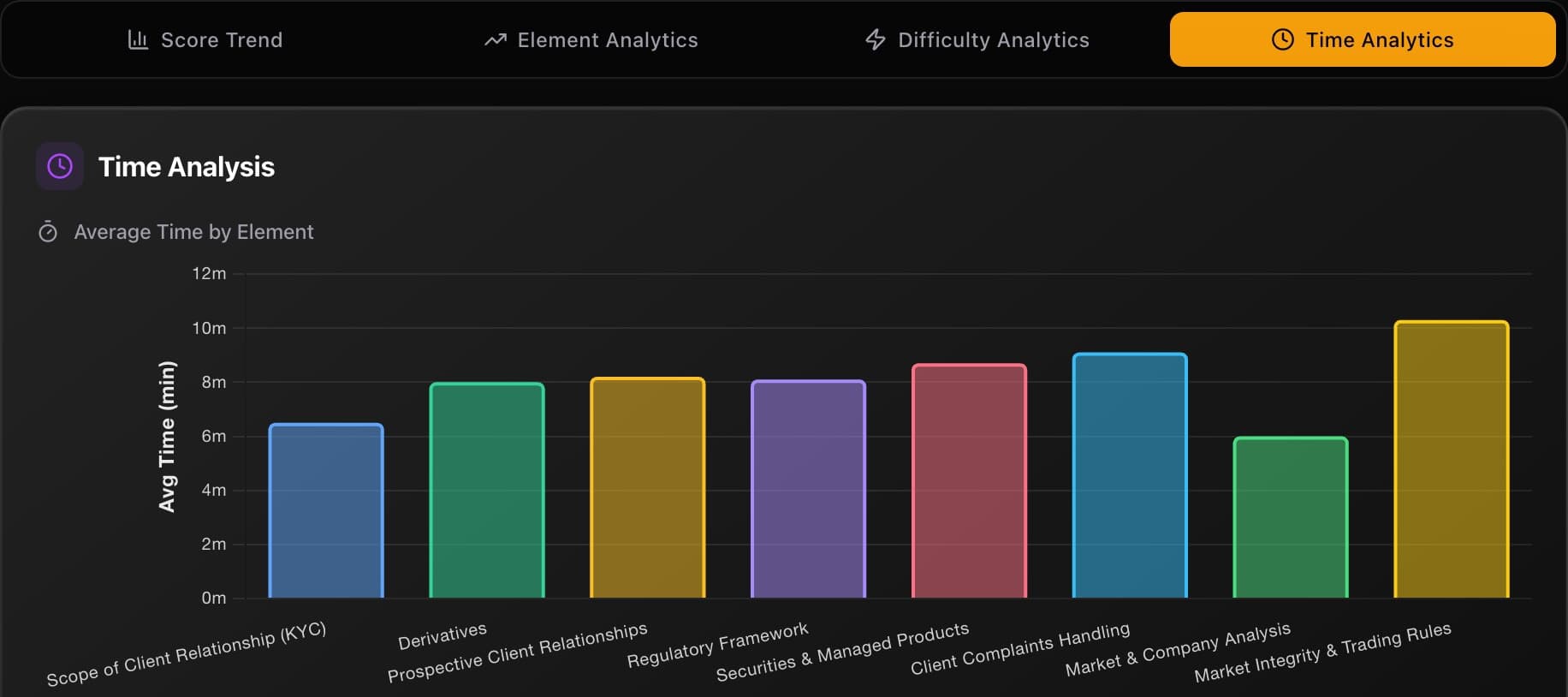
Average Time by Element
Each bar shows how many minutes you spend per 10 questions in a given element. Some variation is normal — regulation-heavy elements with dense text naturally take longer. But outliers tell a story.
In the screenshot, Market Integrity & Trading Rules stands out at roughly 10 minutes, while Scope of Client Relationship (KYC) is the fastest at around 5 minutes. That gap has two possible explanations:
- You're struggling with the material. The questions require re-reading, second-guessing, and process of elimination. Action: go back to the Learning Centre for that element. Build understanding before burning more quiz attempts.
- You're overthinking it. You actually know the content but don't trust yourself, so you deliberate on every option. Action: try timed quizzes where you force a faster pace. If your scores hold, you were overthinking.
Compare time bars against your radar chart scores. If an element takes long and scores low, the material needs more study. If it takes long but scores high, you need to trust your instincts.
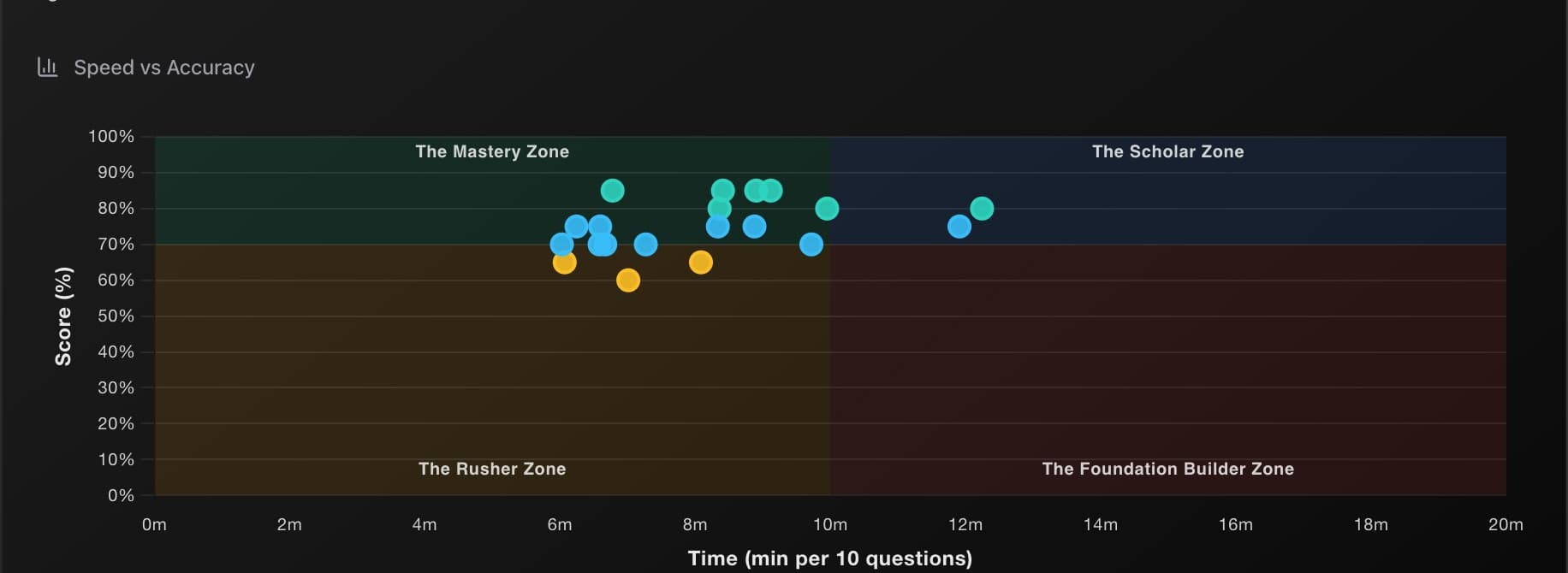
Speed vs Accuracy scatter quadrant
This is the most powerful chart on your entire dashboard. Every dot is a single quiz attempt, plotted by time on the x-axis (minutes per 10 questions) and score on the y-axis. The chart divides into four coloured zones, and each one tells you something different about your study approach.
| Zone | Position | What it means | What to do |
|---|---|---|---|
| The Mastery Zone (green) | Fast + high score | You know the material cold. Efficient and accurate. | Nothing — this is the goal. Move on to weaker elements. |
| The Scholar Zone (blue) | Slow + high score | You're getting the answers right but deliberating too long. | Practice under timed conditions. Your knowledge is there — trust it. |
| The Rusher Zone (orange) | Fast + low score | You're racing through and missing details. | Slow down. Read every option. Check for trick words like "except" and "not." |
| The Foundation Builder Zone (red) | Slow + low score | The material needs more work. Speed isn't the issue — understanding is. | Stop quizzing this element for now. Go back to the Learning Centre and rebuild from the readings. |
In the screenshot, most dots cluster in the Mastery Zone — scores between 70-85% at 5-10 minutes per 10 questions. That's a strong position. But there are a few amber dots dipping into the Rusher Zone around 60-65%, which means some quizzes were rushed. Hover over those dots to see which element and difficulty they belong to — that's where careless mistakes are happening.
Your action: Find your dominant zone. If most dots are in one quadrant, that's your default study mode. Use the table above to adjust. If dots are scattered across multiple zones, sort out which elements land in which zones — the fix is element-specific, not global.
Don't aim for speed
The Mastery Zone isn't about being fast. It's about knowing the material well enough that you don't need to second-guess every answer. Speed is a byproduct of knowledge, not a goal you chase directly. Candidates who try to speed up without building understanding just migrate from Scholar to Rusher — and their scores drop.
Turning analytics into action
Charts without follow-through are just decoration. Here's the 3-step workflow that actually moves your scores.
Check your radar dents
Open Element Analytics. Look at the radar chart. Identify the two deepest dents — the elements where your spider web pulls furthest inward. Go to Custom Mock Exams and build 3-4 quizzes targeting those elements specifically. Take them over the next week, then come back and check if the dents are filling in.
Check your box plot width
Open Difficulty Analytics. Look at the Score Distribution box plots. If any box is noticeably wider than the others, you're volatile at that difficulty level. Filter your quiz history by that difficulty and find the specific topics causing the swings. Target those topics with focused practice — not the whole difficulty level, just the volatile topics.
Find your quadrant
Open Time Analytics. Look at the Speed vs Accuracy scatter plot. Where do most of your dots land? If you're in Scholar, practice timed quizzes to build confidence in your instincts. If you're in Rusher, slow down and commit to reading every option twice. If you're in Foundation Builder, stop quizzing and go back to the Learning Centre — more practice won't help until the understanding is there.
Repeat this workflow every week. The radar dents fill in, the box plots narrow, and the dots migrate toward Mastery. That's not motivation — it's mechanics.