Your brain thinks it knows more than it does
There's a well-documented phenomenon in learning science called the fluency illusion: when you read something clearly written, your brain confuses "this was easy to read" with "I now know this." You finish a reading on suitability requirements, feel confident, and then freeze when a quiz asks you to distinguish between the account appropriateness obligation and the suitability determination.
That gap between feeling like you know something and actually knowing it is where most CIRE candidates lose marks. Not because they didn't study — because they studied passively. They read, they highlighted, they moved on.
The pop quiz and flashcard activities exist to close that gap. They force you to pull information out of your memory instead of just pushing it in — and that act of retrieval is what converts short-term familiarity into something you can rely on in a 3-hour exam.
Pop quizzes
Click Quiz in the sidebar under any concept. You'll see "Pop Quiz!" with 3-6 multiple-choice questions tied directly to the reading you just finished.
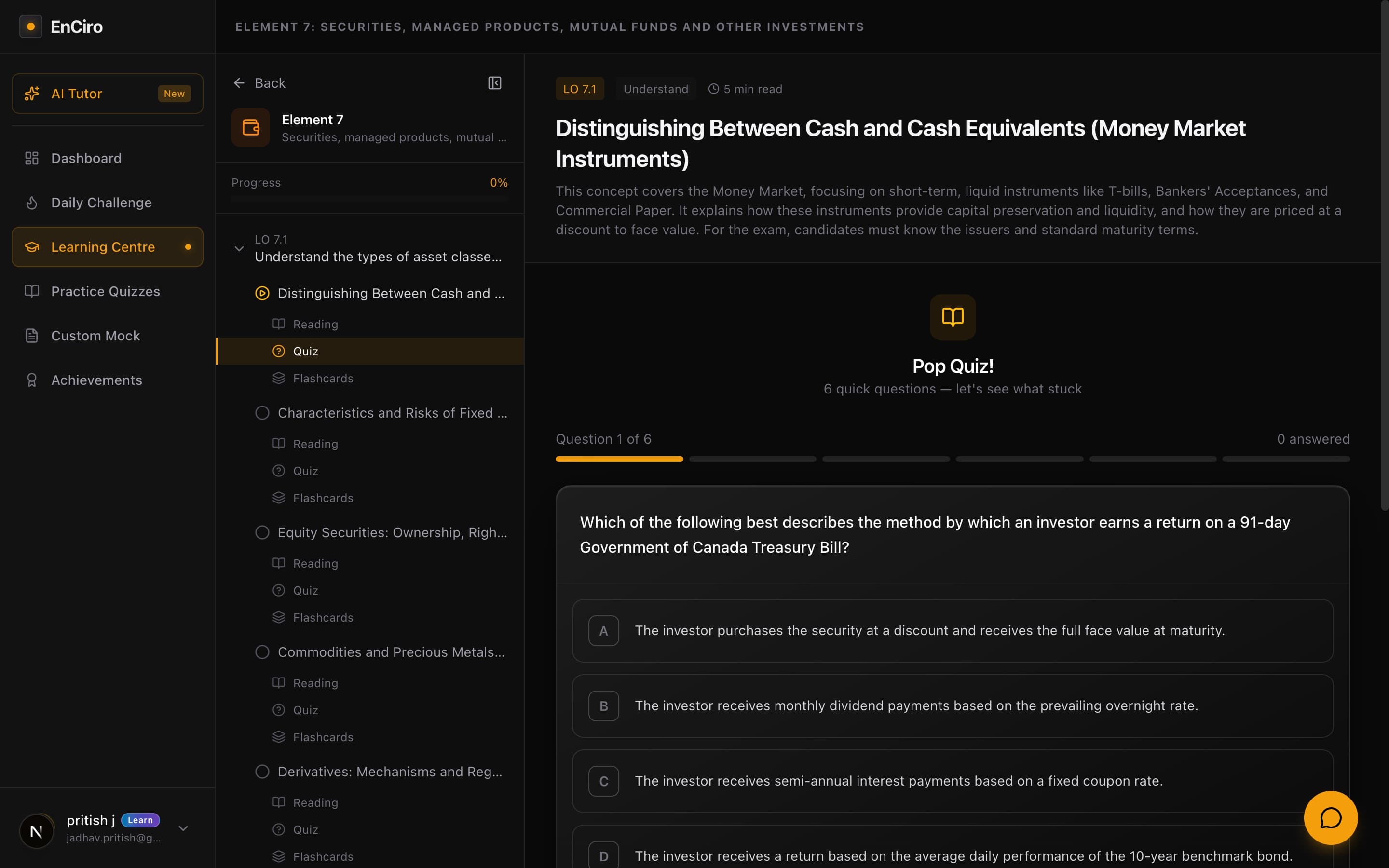
The format mirrors the actual exam: four options (A, B, C, D), one correct answer. This isn't accidental. If you're going to practice, you should practice in the format you'll be tested in.
Why the explanations matter more than the score
The moment you select an answer, every option reveals its explanation — not just the one you picked.
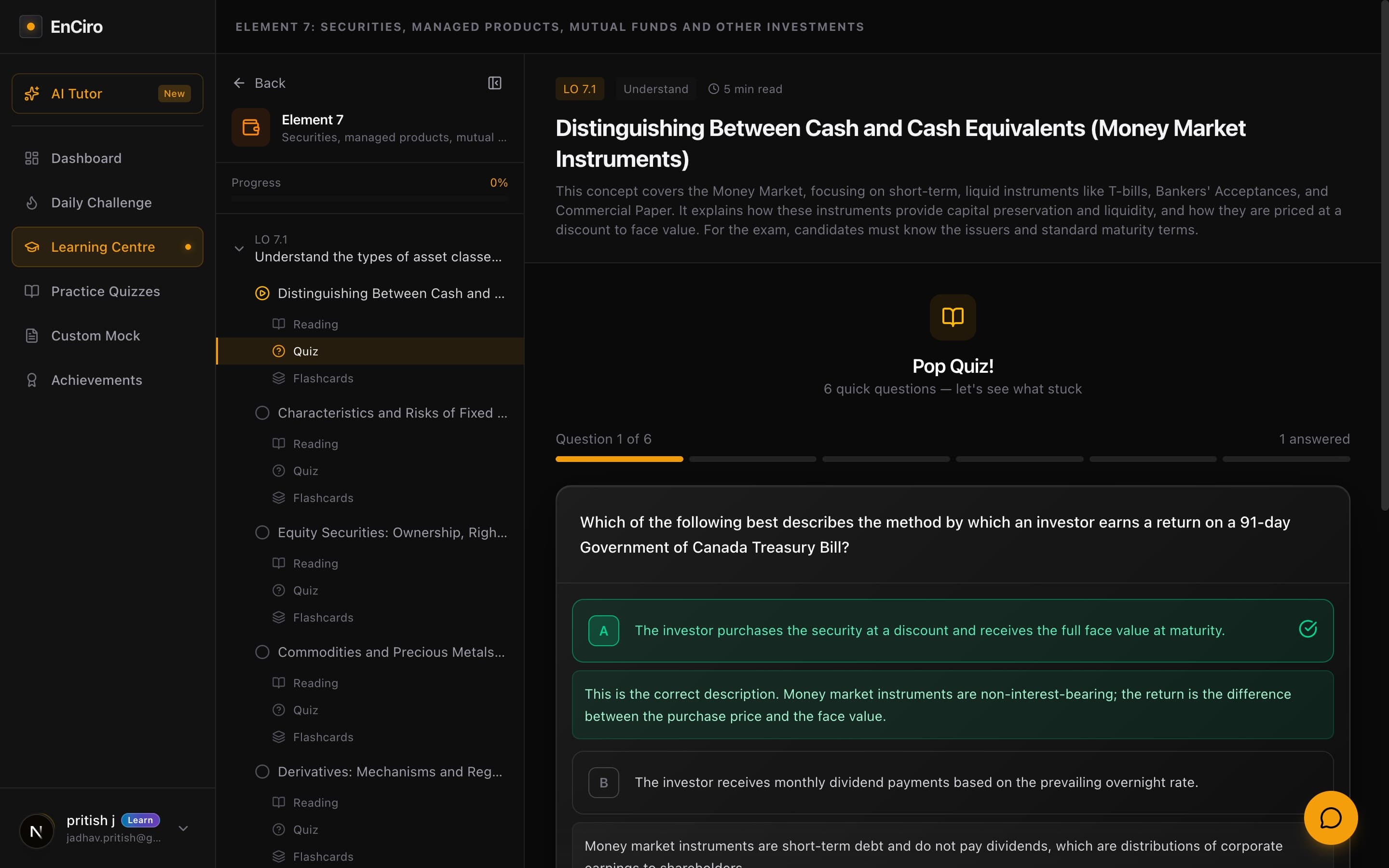
This is the part most study tools skip. Knowing why an answer is wrong is often more valuable than knowing why the right answer is right. If you thought Bankers' Acceptances are backed by the government (they're not — they're backed by the stamping bank), seeing that explanation corrects a specific misconception. Getting a generic "Incorrect, try again" teaches you nothing.
These aren't scored
Pop quiz results don't go on your dashboard. They're not practice quizzes — they're learning tools. Get every question wrong and nobody knows but you. The point isn't to perform. The point is to discover what you missed while the reading is still fresh in your mind.
Flashcards
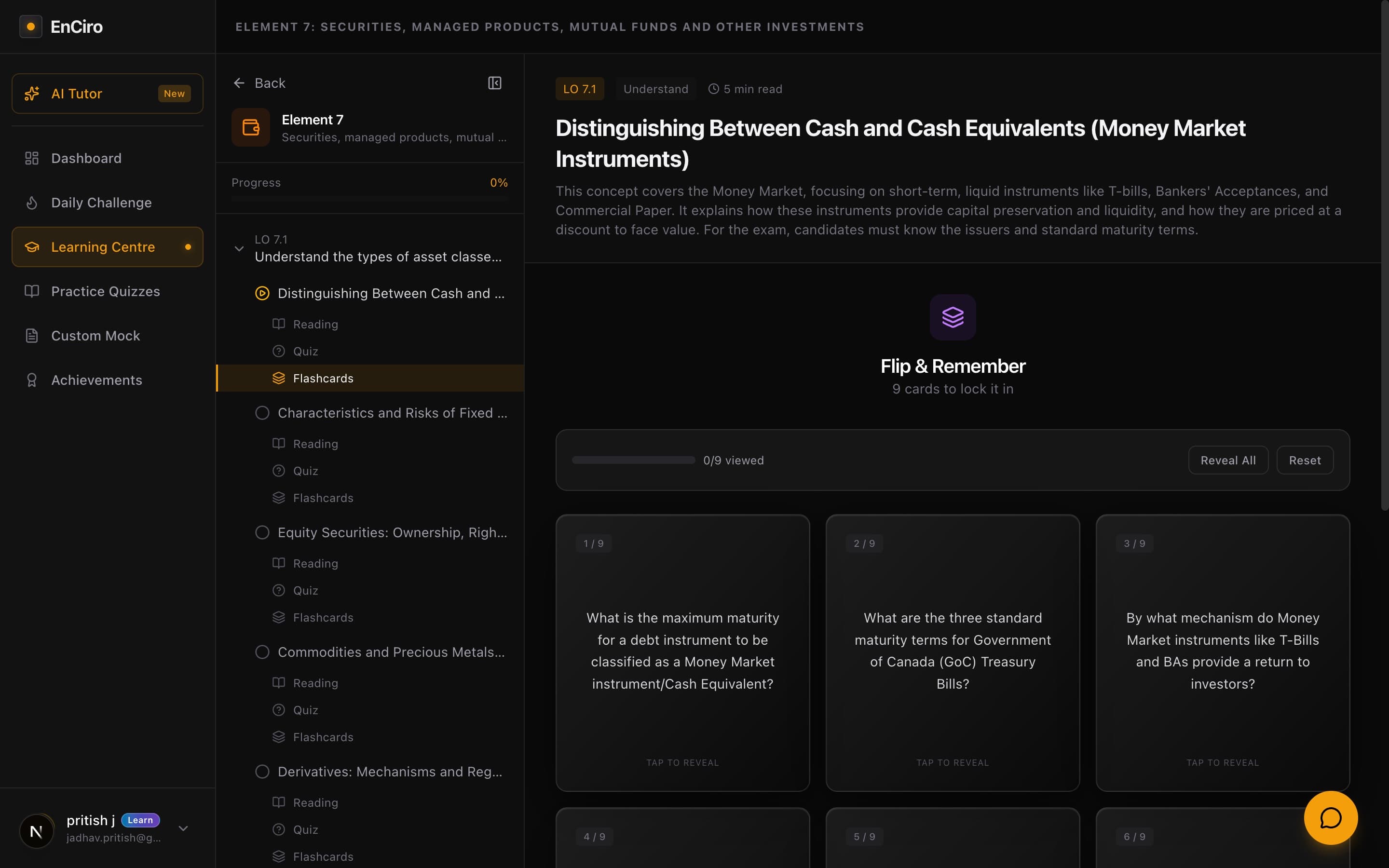
Click Flashcards in the sidebar. You'll see "Flip & Remember" — a grid of cards covering the terms, definitions, and facts the exam tests verbatim.
The struggle is the point
The most important thing you can do with a flashcard is not flip it immediately. Read the question, try to answer it in your head, sit with the discomfort of not being sure — and then tap to reveal.
That discomfort has a name: desirable difficulty. When your brain has to work to retrieve an answer, the memory trace gets stronger. When you just flip and read, you're back to the fluency illusion — it feels like learning, but the information slides out as fast as it went in.
Read the question
Each card targets a specific testable fact — "What are the three standard maturity terms for GoC Treasury Bills?" or "Why does Commercial Paper offer a higher yield than T-Bills?" If the exam could ask it, there's a card for it.
Answer in your head before flipping
Actually try. Even a partial answer counts. "I think it's 91 days, 182 days, and... something" is more useful than immediately seeing "91, 182, 364" — because now your brain has a gap to fill, and filling that gap is what makes the answer stick.
Reveal and compare
Tap to see the answer. Were you right? Close? Completely off? Each outcome tells you something. Right means this one's locked in. Close means one more pass will cement it. Wrong means this card is the most valuable one in the deck — come back to it.
Use Reveal All for a quick scan when you're short on time, or Reset to run through the deck again. The counter at the top tracks how many cards you've seen.
Come back tomorrow, not in five minutes
If you got a card wrong, the instinct is to re-flip it immediately. Resist that. Come back to it tomorrow, or the day after. This is spaced repetition — deliberately letting some forgetting happen so the next retrieval strengthens the memory more. It feels counterintuitive, but it's the single most efficient way to move information into long-term storage.
Where this fits
The pop quiz tells you whether you understood the reading. The flashcards make sure you can recall the specific facts. Together, they convert a 5-minute reading into knowledge you can actually use on exam day.
Once you've been through a few concepts with the full loop — reading, quiz, flashcards — the next step is to test yourself at a higher level. Head to Browsing Quizzes to take a full practice quiz on the element you've been studying. That's where you find out if the Learning Centre content holds up under exam conditions.