
Regulatory content doesn't read like a textbook
A textbook explains ideas. Regulatory content defines obligations. Every sentence in the IDPC Rules exists because someone, somewhere, needed a legal boundary drawn. The result is language that's exhaustive by design — and exhausting to study from.
Reading the CIRE source material the way you'd read a textbook (skim, highlight, move on) doesn't work. You'll miss the one word that changes the meaning of a rule. You'll confuse two terms that sound identical but have different regulatory consequences. You'll think you understood a paragraph, and then get every quiz question on it wrong.
The Learning Centre readings are built for this problem. Each concept takes one focused topic from the source material, strips out the legal scaffolding, and explains it in plain language — while making sure every testable detail is still there.
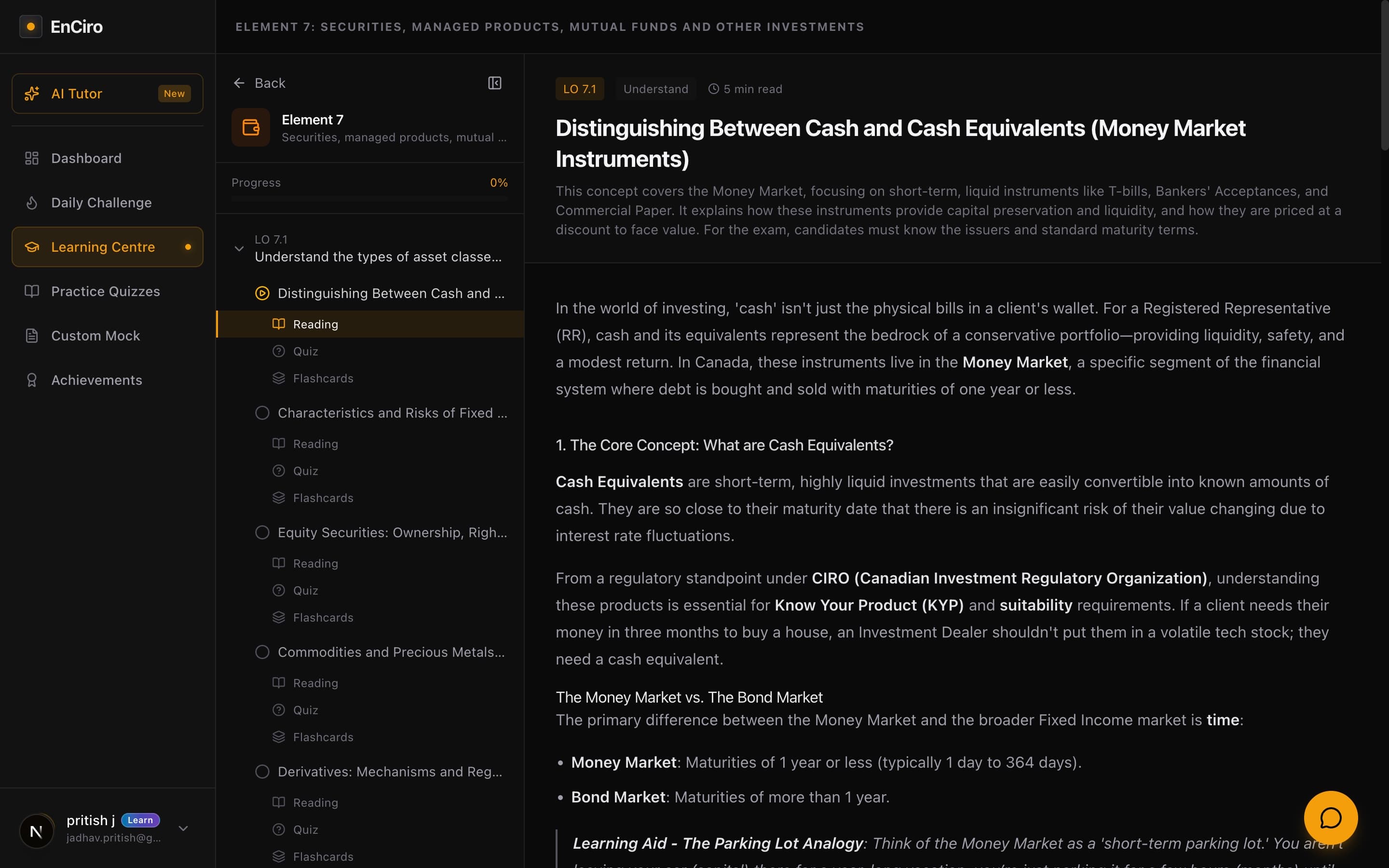
What the badges at the top tell you
Every reading starts with three pieces of information that shape how you should study it:
LO number (e.g., "LO 7.1") tells you which Learning Outcome this concept maps to in the official CIRE syllabus. This matters because it connects what you're reading to how it'll be tested.
Cognitive level tells you how the exam will test this concept. A "Remember" reading means the exam wants you to recall specific facts — rule numbers, maturity terms, regulatory bodies. Flashcards are your priority here. An "Apply" or "Analyze" reading means the exam will hand you a scenario and ask you to use the knowledge. For these, understanding why a rule exists matters more than memorizing its exact wording. (See the overview for all four cognitive levels.)
Estimated reading time is typically 3-5 minutes. One concept, one coffee break.
How to actually read this stuff
The readings include specific tools to help you learn regulatory content — not just read it.
Bold key terms are exam signals. When you see "Money Market," "CIRO," "Know Your Product (KYP)," or "suitability" in bold, that's a term the exam is likely to test. If you finish a reading and can't define a bold term without scrolling back, you've found a gap. That's what flashcards are for.
Comparison tables are where exam questions come from. The CIRE loves "which of the following" questions that test whether you can distinguish between similar things — T-Bills vs. Bankers' Acceptances vs. Commercial Paper, for instance. The readings lay these out side by side. Read them once to understand each row, then read them again to understand the differences between the rows. That second pass is where the exam points are.
Learning aids like analogies make abstract regulatory concepts stick. The "Parking Lot Analogy" compares money market instruments (short-term parking) to bonds (long-term parking) — the kind of mental hook that helps you recall the distinction under exam pressure, not just while you're staring at the page.
Read with a quiz mindset
As you read, ask yourself: "If I had to answer a multiple-choice question on this paragraph, could I?" If the answer is no, slow down. That's the paragraph that'll show up on the quiz — and on the exam.
When you finish
Hit Mark Complete & Continue at the bottom. Your progress updates, and it automatically takes you to the quiz for that concept — no navigating, no figuring out what's next.
You can always come back. Marking a reading complete doesn't lock it. In fact, the most effective thing you can do after getting a pop quiz question wrong is go back to the reading and find where that concept was explained. Re-reading after you know what you missed is significantly more effective than re-reading before — your brain now knows what to pay attention to.
Next up
The reading gave you the foundation. Now it's time to find out what actually stuck. Head to Pop Quizzes & Flashcards to see how the active recall tools work.