
This isn't ChatGPT with a CIRE label
You could ask ChatGPT about CIRO rules. It would give you a plausible-sounding answer — maybe even a correct one. But it would be pulling from whatever regulatory fragments ended up in its training data, with no way to verify, no citations, and no idea whether you're confusing IDPC Rule 3200 with Rule 3700.
EnCiro's AI tutor is a fundamentally different thing. It has direct access to the actual regulatory documents that the CIRE tests you on. When you ask about suitability obligations, it doesn't guess — it finds the specific rule and cites it in its answer. "According to IDPC Rule 3200(3)..." Not a paraphrase. Not a summary from a blog. The rule itself.
And it knows you. It can pull your quiz history, see which elements you're strong on, which ones are dragging your average down, and whether your scores are trending up or down. No generic advice. Personalized guidance based on your actual performance data.
This is what the future of exam prep looks like: not one-size-fits-all content, but an intelligent tutor that meets you where you are. EnCiro is leading that shift.
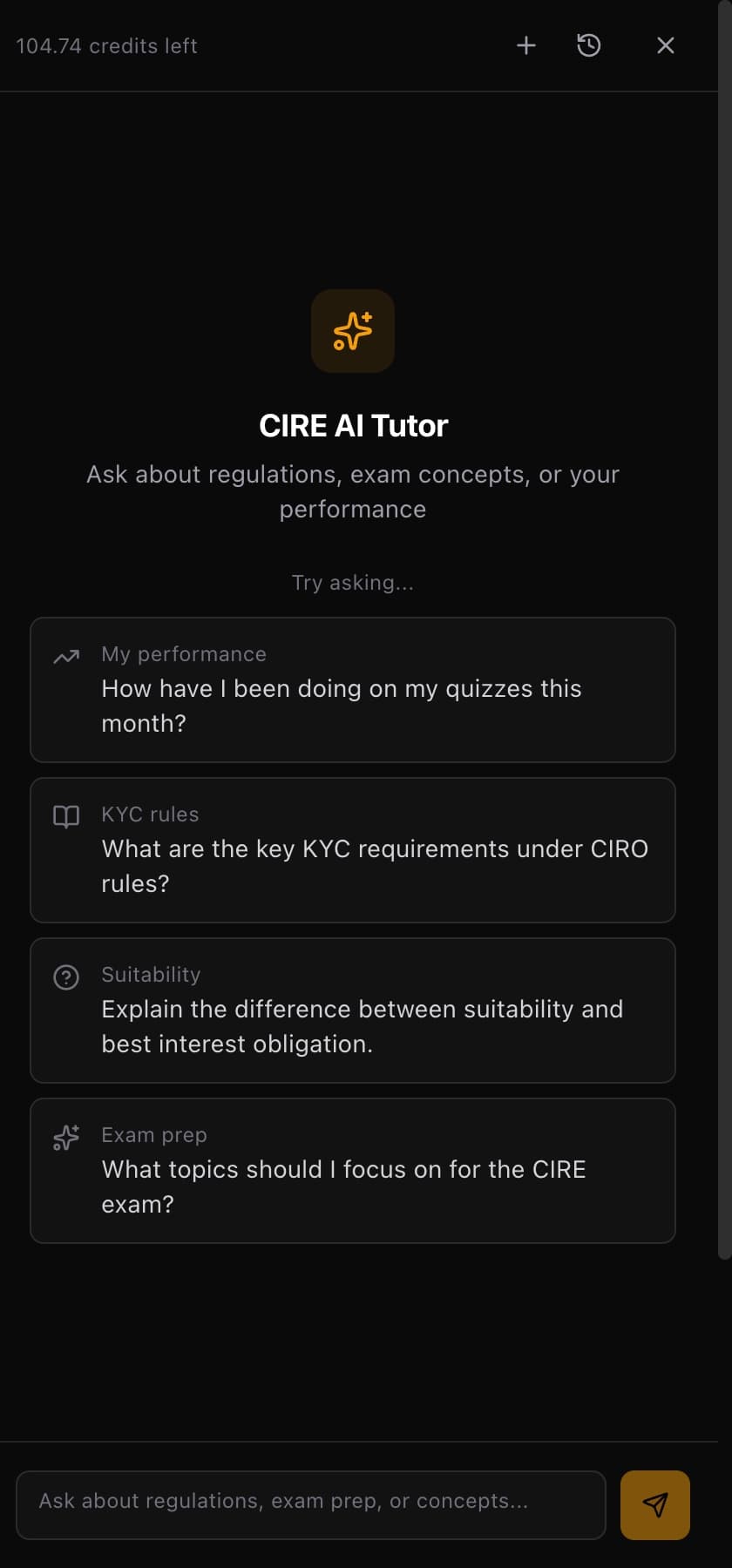
It knows the rules. And it knows you.
Two things separate this from any general-purpose AI:
It can cite the actual regulations. Ask about any CIRO rule, any UMIR provision, any relevant federal statute — the tutor pulls the actual regulatory text and references it by rule number. Not a vague summary. Not a hallucinated answer that sounds right but isn't. The real thing, from the source.
It can see your performance data. The tutor can pull your quiz history, analyze your scores by element, identify your strengths and weaknesses, and track whether your scores are trending up or down. It doesn't just know the curriculum — it knows where you stand in it. Ask "what should I study next?" and it gives you an answer based on your actual data, not generic advice.
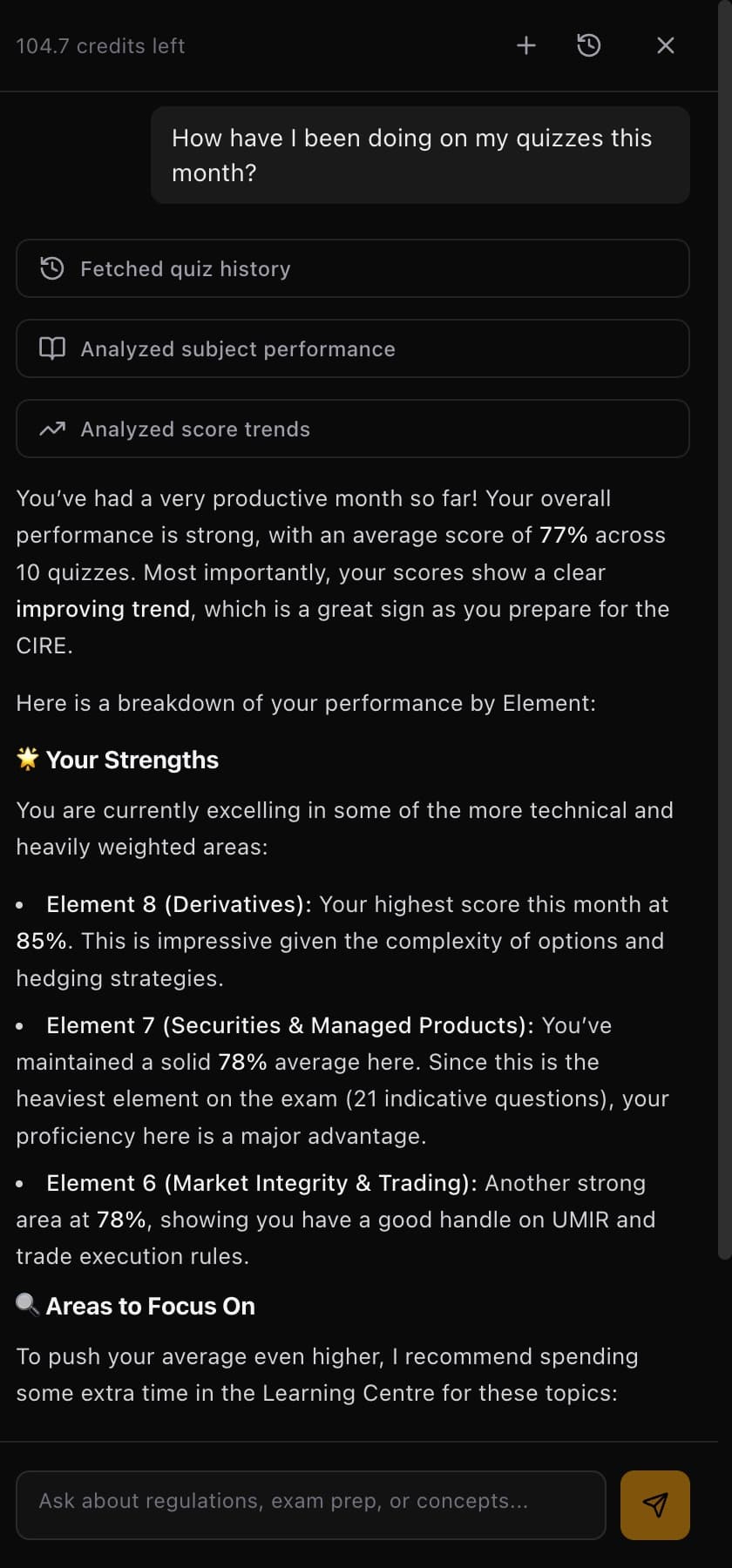
It's always right there
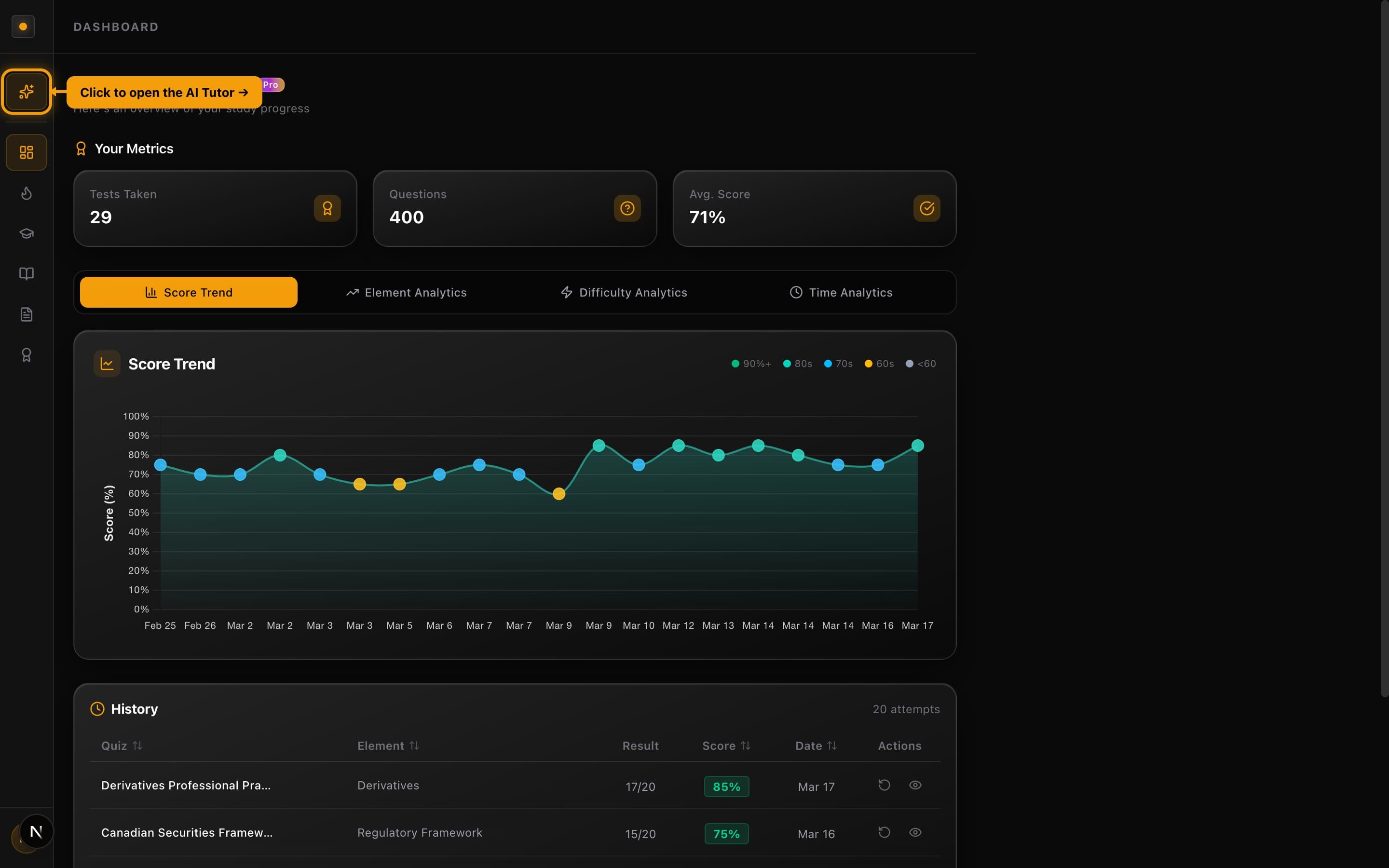
Click AI Tutor in the dashboard sidebar and the chat panel slides in from the right. It doesn't take over the screen — it sits beside whatever you're already doing. Reading a concept in the Learning Centre and hit something confusing? Ask the tutor without leaving the page. Reviewing quiz results and want to understand why you got a question wrong? The tutor is right there, looking at the same screen you are.
This isn't a separate app you have to switch to. It's a conversation that lives inside your study workflow. Your credit balance is always visible at the top of the panel, and your conversation history is one click away.
What makes a great question
The tutor's answers are only as good as your questions. Here's the difference:
| Vague (meh answer) | Specific (great answer) |
|---|---|
| "Explain bonds" | "What's the difference between a bond's coupon rate and its yield to maturity?" |
| "Help me with ethics" | "Under IDPC Rule 1400, when does a conflict of interest require disclosure vs. avoidance?" |
| "I don't understand this" | "Can you walk me through why option C is correct for this question about mutual fund trailing commissions?" |
Specificity is free. The more context you give, the more targeted the response — and the more value you get per credit.
Three moves for better conversations
Name what confuses you
Don't say "I don't get suitability." Say "I understand that suitability requires matching investments to a client's risk tolerance, but I don't understand how it differs from the best interest obligation introduced by the Client Focused Reforms." That kind of specificity gets you an answer that actually resolves the confusion.
Ask follow-ups
If the first answer doesn't fully click, push back. "Can you give me a simpler analogy?" or "How would this play out with a retired client on a fixed income?" The tutor doesn't get frustrated. Keep asking until it lands.
Use it right after quizzes
The best time to ask the tutor is immediately after reviewing quiz results. Your brain is already primed on the topic, the question is right in front of you, and the explanation is fresh. This is when a single conversation delivers maximum value.
What it's great at
- Citing specific rules — "According to IDPC Rule 3200(3)..." Not vague summaries. The actual rule, from the actual regulatory text.
- Breaking down complex concepts — taking dense CIRE material and making it click with analogies and client scenarios
- Analyzing your performance — pulling your quiz data and telling you exactly which elements need work and what to study next
- Comparing similar concepts — "What's the difference between suitability and appropriateness?" or "How do MERs and TERs relate?"
- Connecting concepts to elements — it knows which CIRE element every topic belongs to, so it can always tell you where something fits in the bigger picture
Ask it to analyse your weak spots
Try: "What are my weakest elements and what should I study next?" The tutor will pull your performance data, identify your lowest-scoring elements, and recommend specific topics to focus on. It can even suggest building a Custom Mock targeting those exact weaknesses.
Conversations are saved
Every chat is saved to your conversation history — click the history icon at the top of the panel to browse past conversations. Re-reading old conversations costs zero credits. Think of it as building your own personalized study notes, one conversation at a time.
Before starting a new conversation on a topic, skim your history. You might have already asked a similar question weeks ago. The old answer is instant and free.
Credits are variable, not flat
Each message costs a small, variable number of credits based on the complexity of the conversation — typically between 0.01 and 0.10 credits. Simple questions cost less; long, multi-step regulatory deep dives cost more. Your credit cost is shown after every response. See AI Credits Explained for the full breakdown.