
You weren't meant to learn from those documents
The CIRE source material is regulatory law. The IDPC Rules define "hedger" across three levels of nested sub-clauses. The anti-money laundering act is bilingual federal legislation. The suitability requirements cross-reference six other rule series before getting to the point.
Nobody sits down with these PDFs and thinks "yes, I am learning." You read a paragraph, re-read it, realize you absorbed nothing, and start over. The language is precise because it has to be. But precise and learnable are very different things.
The Learning Centre exists because of that gap. Same regulatory content, rewritten so a human being can actually understand it on the first pass. Every concept is broken into three activities — a reading, a pop quiz, and flashcards — so you're actually retaining the material, not just enduring it.
Elements: the 9 subjects of the CIRE
The CIRE exam is divided into 9 elements — think of them as subjects. Each element covers a distinct area of the securities industry, from KYC and suitability rules (Element 1) to derivatives (Element 8) to conflicts of interest and ethics (Element 9). The exam has 120 multiple-choice questions, and each element has a specific weighting — Element 1 alone accounts for 27 questions, while Element 8 has just 7.
Each element contains multiple learning outcomes (LOs), and each LO is tagged with a cognitive level that tells you how the exam will test it:
| Level | What the exam expects | Example |
|---|---|---|
| Remember | Recall facts, rules, definitions | "Which body is responsible for fiscal policy in Canada?" |
| Understand | Explain or interpret a concept | "Which best describes the role of the middle office?" |
| Apply | Use knowledge in a specific scenario | "Calculate the average return of the three funds below." |
| Analyze | Compare, contrast, draw conclusions | "Given this client's information, which product best meets their needs?" |
These levels are cumulative — an "Apply" question can also test whether you remember and understand the underlying concept. This matters for how you study: a "Remember" concept needs flashcard drilling, but an "Analyze" concept needs you to practice with scenarios, not just memorize definitions.
Where to start: the priority tiers
When you open the Learning Centre, the 9 elements are sorted into three tiers based on how heavily each is weighted on the exam. This isn't alphabetical order — it's a study strategy.

| Tier | What it means | Exam weightage |
|---|---|---|
| High Yield | These elements carry the heaviest exam weight. If you're short on time, start here. | ~49% of exam |
| Core | Substantial coverage on the exam. Don't skip these. | ~32% of exam |
| Foundational | Smaller share of marks, but still tested. Cover these once your High Yield and Core are solid. | ~19% of exam |
Nearly half the exam comes from just the High Yield tier. If you only have two weeks, those elements are your entire study plan. If you have two months, start there anyway — confidence on half the exam changes how you approach the other half.
Inside an element
Click any element card and you'll see a sidebar on the left with every concept organized under its Learning Outcome, and the content area on the right.
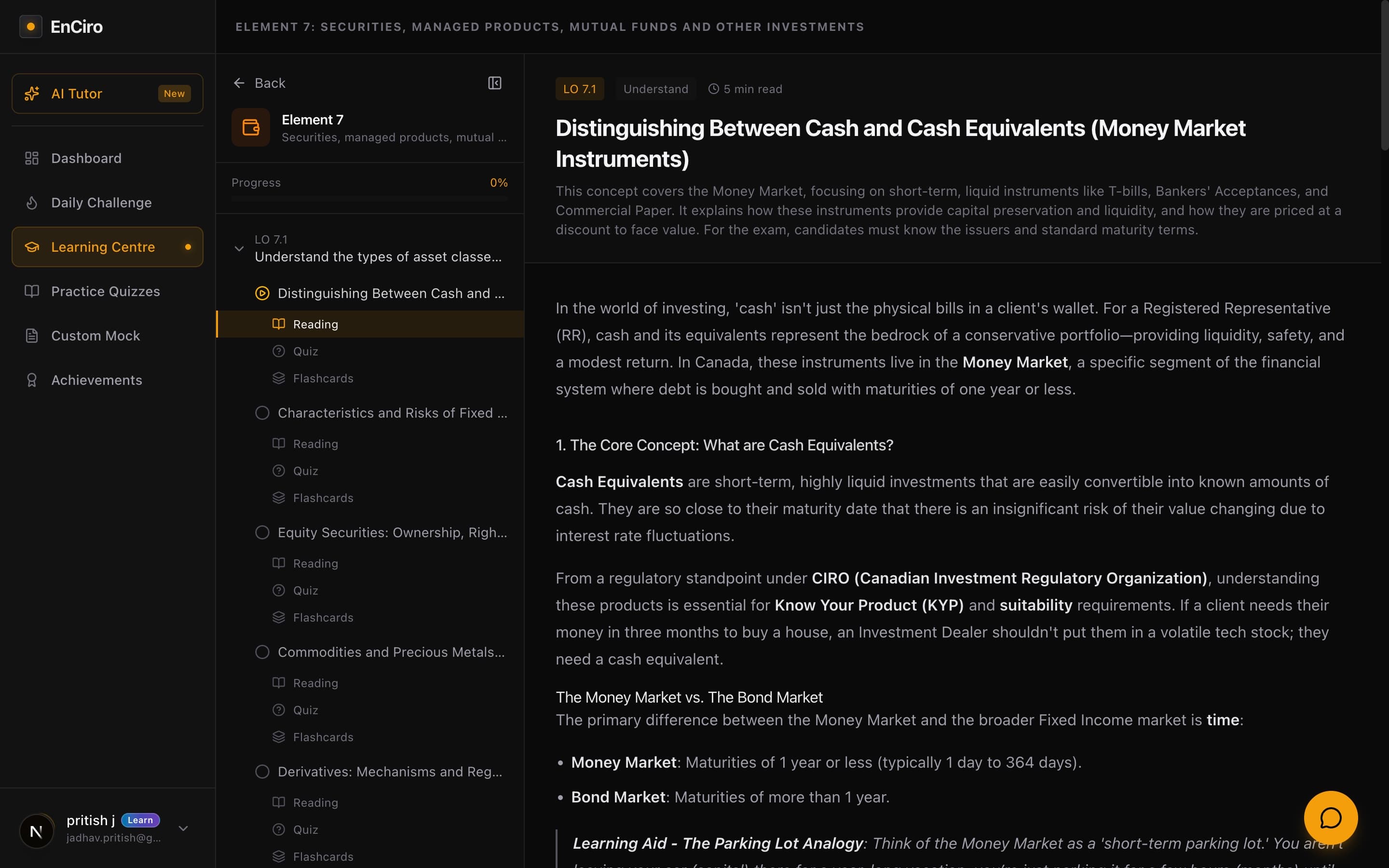
A concept is one focused topic — "Distinguishing Between Cash and Cash Equivalents" or "Equity Securities: Ownership, Rights, and Features." Not a chapter. Most readings take about 5 minutes, which means you can finish a full concept (reading + quiz + flashcards) in a single coffee break.
Each concept has three activities in the sidebar: Reading, Quiz, and Flashcards. The progress icons next to each tell you where you stand — completed, in progress, or not started.
3 concepts free in every element
You can try the first 3 concepts in any element without upgrading — no credit card, no trial countdown. That's enough to experience the content quality and the full learning loop before deciding to unlock the rest.
Why three activities, not one
Most study tools give you content to read or questions to answer. The Learning Centre does both — in a specific order — because that's how memory formation actually works.
Reading gives you the foundation. The content is rewritten from regulatory source material into clear explanations with bold key terms, comparison tables, and learning aids like analogies. When you finish, hit Mark Complete & Continue and it advances you automatically.
Quiz tests whether you understood what you just read. 3-6 multiple-choice questions, same format as the real exam, with instant explanations for every option — right or wrong. This is retrieval practice: the act of pulling information out of your memory is what strengthens it, not reading it one more time.
Flashcards drill the specific terms and facts you need to memorize. Tap to reveal, check your recall, move on. This targets the "Remember" cognitive level — the definitions, rule numbers, and regulatory specifics that the exam tests verbatim.
The sequence matters. Reading without testing is passive — you'll overestimate what you know. Testing without reading is guessing. The loop forces you through all three stages: encode, retrieve, reinforce.
The order matters
Read first, quiz second, flashcards third. Skipping the reading and jumping to the quiz is tempting — but you'll just be guessing, and getting questions wrong without context doesn't teach you anything. The reading is what makes the quiz and flashcards useful.
We cover the details of each activity in their own tutorials: Reading the Content and Pop Quizzes & Flashcards.
How to use this
Pick your weakest High Yield element
Don't start at Element 1 because it's first. Start at the High Yield element where you have the least confidence. If you're not sure, take a quick practice quiz on each — your dashboard analytics will show you exactly which elements need the most work.
One concept per session, full loop
Read the concept. Take the quiz. Flip through the flashcards. The whole thing takes 10-15 minutes. Do one concept per day and you'll cover an entire element in a week or two. That's not a grind — that's a coffee break.
When scores plateau, go back to readings — not more quizzes
This is the mistake most candidates make. Your dashboard shows you're stuck at 55% on an element, so you take more quizzes. But if the comprehension isn't there, more practice doesn't fix it — it just makes you faster at guessing wrong. Go back to the readings for that element. Re-read the concepts you got questions wrong on. The quiz scores will follow.
The Learning Centre picks up where you left off every time you come back — it remembers the exact concept and activity, so you never waste time reorienting. Open it, hit "Start Reading," and you're back in the loop.