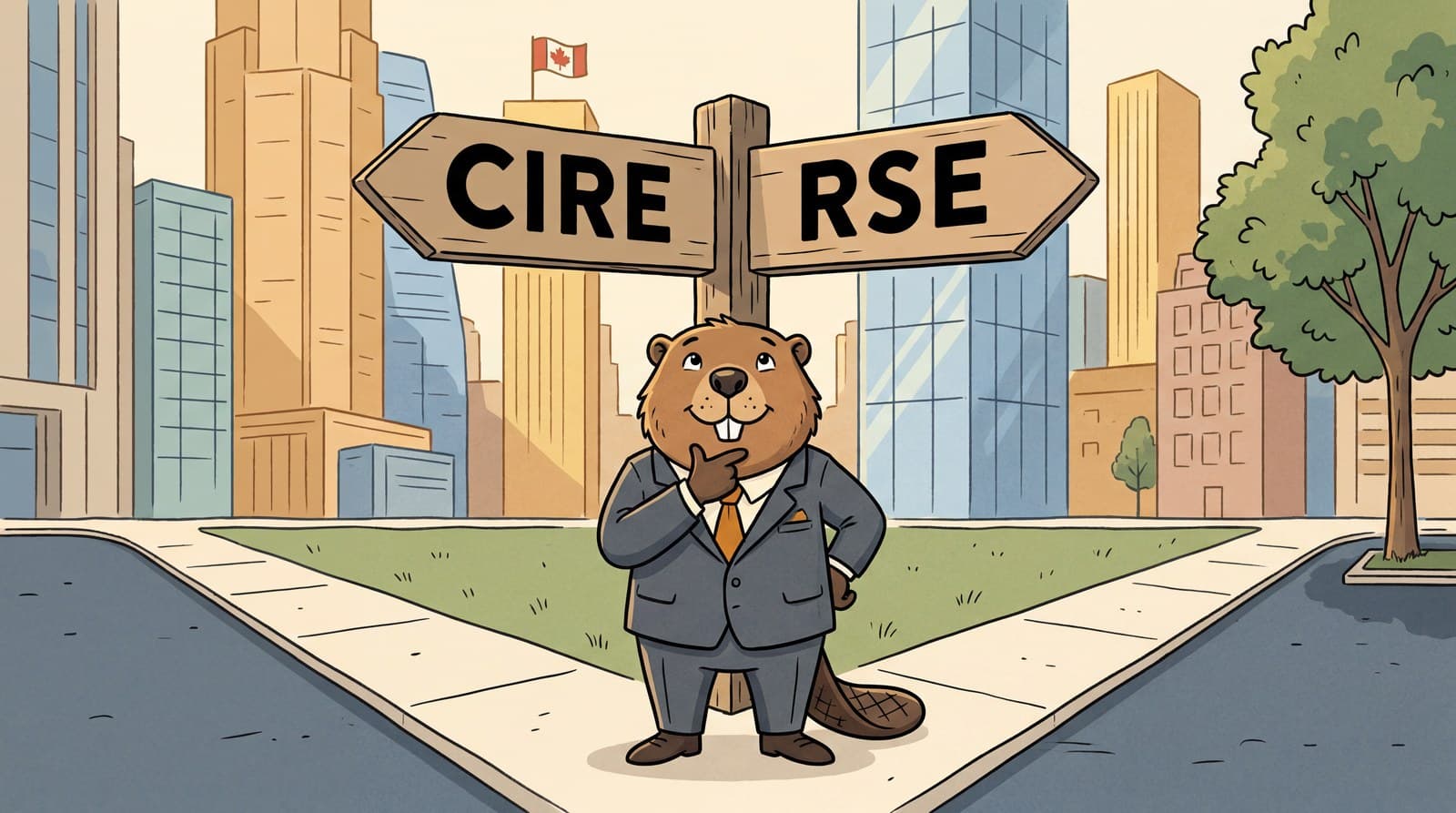

Job postings make this look harder than it is. One says "CSC required" (outdated — more on that below). Another says "successful completion of applicable proficiency requirements." A third lists exam acronyms that didn't exist three years ago. Behind all of it sits a simple system: since January 2026, CIRO licenses people at investment dealers through its own exams, and which ones you need follows directly from what your job actually is.
Answer one question — what will you do at the dealer? — and the exam list writes itself.
The short version: Everyone starts with the CIRE — it's the entry exam for all investment-dealer registration. Then: executing client orders only → CIRE alone. Advising retail clients → CIRE + RSE. Servicing institutional clients → CIRE + ISE. Dealing in derivatives adds the Derivatives Exam, at retail as well as institutional. No mandatory courses anywhere — CIRO publishes free syllabi and practice exams, and how you prepare is up to you.
Which Exams Does Your Role Need? The Decision Map
| Your role at the dealer | Registration category | Exams required |
|---|---|---|
| Execute trades on client instructions — no advice | Investment Representative (IR) | CIRE |
| Execute trades in derivatives, no advice | Investment Representative (derivatives) | CIRE + Derivatives Exam |
| Advise retail clients — recommendations, portfolios | Registered Representative (retail) | CIRE + RSE |
| Advise retail clients, including derivatives | Registered Representative (retail, derivatives) | CIRE + RSE + Derivatives Exam |
| Service institutional clients — funds, treasuries, desks | Registered Representative (institutional) | CIRE + ISE |
| Institutional, including derivatives | Registered Representative (institutional, derivatives) | CIRE + ISE + Derivatives Exam |
That's the client-facing half of the system. The firm-side roles — supervision, the executive suite, the trading desk — have their own exams, and they're mapped further down.
Two structural facts make the whole system click:
- The CIRE is the front door for everyone. There's no path into investment-dealer registration that skips it, and both the RSE and ISE list it as a hard prerequisite. Whatever your destination, your first booking is the same.
- The RSE and ISE are parallel, not sequential. They're the retail fork and the institutional fork of the same junction. You take the one your registration category requires — almost never both, and in no particular order because there isn't one.
In practice, your sponsoring dealer confirms the category: firms file your registration, the category comes with defined proficiency requirements, and HR or compliance can tell you which one your offer letter maps to. If you're choosing a career direction rather than decoding an offer, the fork is a genuine decision — we've written a full RSE-vs-ISE comparison for exactly that.
One scope note: this map covers investment dealer registration. Mutual-fund-dealer-side registration (the former MFDA world, now also under CIRO) follows its own proficiency requirements — if that's your firm type, confirm the requirements with them.
The Three Exams at a Glance
| CIRE | RSE | ISE | |
|---|---|---|---|
| Role | Entry exam for everyone | Retail advice | Institutional service |
| Questions | 110 | 120 | 100 |
| Duration | 2 hours | 3 hours | 2.5 hours |
| Elements | 9 | 9 | 7 |
| Heaviest element | Securities, managed products & mutual funds (19.1%) | KYC & suitability (22.5%) | Securities analysis (31%) |
| Character | Broad, rules and recall | Client judgment | Analysis concentration |
| Cost | $475 ($300 retake) | $475 ($300 retake) | $475 ($300 retake) |
| Prerequisite | None | CIRE | CIRE |
Each is proctored (remote or in person), allows 3 attempts per enrollment, and has no published pass mark — scores are set psychometrically and you receive a pass or fail. Deep dives: CIRE · RSE · ISE.
All Nine Exams, and Who Actually Writes Them
Those three carry the main licensing path. The other six exist, they're real exams with published syllabi, and most people never learn what's in them because they attach to roles you arrive at later. Here they all are, with the format taken from CIRO's own syllabi:
| Exam | Questions | Duration | Elements | Who writes it |
|---|---|---|---|---|
| CIRE | 110 | 2 h | 9 | Everyone, as the entry exam |
| Retail Securities | 120 | 3 h | 9 | RRs advising retail clients |
| Institutional Securities | 100 | 2.5 h | 7 | RRs covering institutional clients |
| Derivatives | 120 | 3 h | 8 | Anyone dealing or supervising in derivatives |
| Supervisor | 90 | 3 h | 9 | Branch and designated supervisors |
| Director and Executive | 75 | 2.5 h | 8 | Directors, Executives, the UDP |
| Chief Compliance Officer | 90 | 3 h | 13 | The designated CCO |
| Chief Financial Officer | 90 | 3 h | 15 | The designated CFO |
| Trader | 100 | 2 h | 10 | Traders, plus whatever the marketplace requires |
A few things fall out of that table that nobody puts in a job posting.
The Derivatives Exam is the joint-heaviest paper CIRO sets. 120 questions in 3 hours, the same load as the RSE, and it's the one that stacks on top of another exam rather than replacing it. Its weighting is concentrated too: 22 questions on derivative pricing and 26 on strategies, out of 120. If derivatives are anywhere in your mandate, budget for it properly.
The CFO Exam has fifteen elements. Fifteen. The CIRE, which is the entry exam for an entire industry, has nine. Same 90 questions as the CCO paper, spread across half again as many topics, which makes it the thinnest coverage per element of any of the nine — three questions on UDP responsibilities, four on significant areas of risk. Breadth is the whole difficulty.
The Supervisor Exam front-loads account approvals. 20 of its 90 questions sit in Element 4, with another 15 on account activity. More than a third of the paper is about approving and then watching accounts, which is a fair description of the job.
Only the firm-side exams use item sets — a shared scenario followed by a cluster of linked questions, where misreading the scenario costs you several marks at once. The Supervisor, CCO and CFO papers are 60 standard plus 30 item set; Director and Executive is 50 plus 25. The CIRE, RSE, ISE, Derivatives and Trader papers are straight multiple choice throughout. If you're moving from a client-facing exam to a supervisory one, that format change is the part nobody warns you about.
The Trader Exam is the odd one out. It's the only exam on the list where passing isn't the end of it: Rule 2603(1)(i)(n) requires the Trader Exam "in addition to any exam mandated by the applicable marketplace." The TSX and the other venues set their own, and CIRO's exam doesn't cover you for those.
If one of the six is in your future, CIRO publishes a syllabus, a study guide and a practice exam for each, free, at its exam hub. Our question banks cover the CIRE, RSE and ISE, which are the three almost everyone meets first.
The Second Gate: Education and Experience
Exams are one half of the requirement. The other half has no exam attached, and it catches people who assumed passing was the whole job.
Rule 2603(1)(ii) sets a minimum education or experience bar for seven approval categories, on top of whatever exams they need:
| Category | Minimum |
|---|---|
| Registered Representative | Relevant diploma or degree, or 4 years relevant experience |
| Supervisor | 2 years relevant experience |
| UDP and Executive | 2 years relevant experience |
| Chief Compliance Officer | 5 years at a dealer with 3 in compliance, or 3 years professional services with 12 months at a dealer |
| Chief Financial Officer | Accounting designation, finance degree or diploma, or equivalent experience |
| Associate Portfolio Manager | 2 years relevant investment management experience, within the last 3 |
| Portfolio Manager | 4 years with the CIM, or 1 year with the CFA Charter |
Investment Representative is absent from that list, which is the quiet reason the IR route matters: it's the only client-facing category with no education or experience floor. CIRO's definition of "relevant" is also far wider than most people assume — kinesiology and architecture are on its own list of acceptable degrees. We've unpacked the whole thing in A Degree or Four Years.
One more worth knowing while you're here: a Supervisor who meets that two-year experience bar is exempt from the CIRE entirely.
Common Situations, Decoded
"I got an offer at a bank branch / wealth management team." Retail advisory → CIRE, then RSE. Your firm will confirm the category; this is the most common path into the industry.
"I'm joining a call centre / order-execution desk." If the role is executing client instructions without advice, that's Investment Representative territory: the CIRE alone. If the role later evolves into advising, the RSE joins the list then — many people sequence their career exactly this way, earning while they study.
"I'm going institutional — sales, trading, coverage." CIRE, then ISE. If derivatives are in the mandate, the Derivatives Exam stacks on top — a 120-question, 3-hour paper, the joint-longest of the nine.
"I'm a student deciding what to aim for." You can't book any of these without direction, but you can prepare: the CIRE is in your future no matter which fork you take, so starting there is never wasted. For the fork itself, the RSE-vs-ISE comparison doubles as an honest preview of the two careers.
"I already work in finance — do I still start at the CIRE?" For investment-dealer registration, yes. The proficiency model is exam-based precisely so experienced people can demonstrate competency directly — no mandatory courses, just the exam. Industry veterans typically clear the CIRE quickly; a free readiness check will show you how much of it you already know.
What If a Job Posting Still Says "CSC Required"?
Then the posting predates the 2026 proficiency change, or the employer's checklist does. Effective January 1, 2026, the Canadian Securities Course no longer qualifies you for CIRO approval at an investment dealer — CSI's own course page says so. The licensing requirement is CIRO's exams, starting with the CIRE. If you enrolled in the CSC before 2026, a narrow transition window may still recognize it (course and exams done, and your dealer's approval application filed, before January 1, 2027). We've covered the whole story — what changed, the transition conditions, and what to do mid-course — in Canadian Securities Course: What Replaced It, with the exam details in the CSC exam guide.
Worth asking the employer directly: "Is this still current, given CIRO's new proficiency rules?" You may save yourself a four-figure course fee and a semester.
Costs and Timeline, End to End
The full journey into a licensed retail or institutional role, at CIRO's published fees:
- CIRE: $475 (plan for 6–8 focused weeks of prep)
- RSE or ISE: $475 (plan 4–8 weeks for the RSE; 4–10 for the ISE depending on quant background)
- Retakes, if needed: $300 each, 3 attempts per enrollment
Call it roughly $950 in exam fees and a few months of disciplined study from zero to a fully-licensed advisory or institutional role — with no mandatory course fees on top. (The open model also means preparation quality is entirely on you, which is the honest sales pitch for practicing against question banks built per exam rather than generic notes.)
Whichever exam the map hands you, the same three tools de-risk it: the official syllabus (free, from CIRO's exam hub), a diagnostic to find your real starting point (our free readiness checks: CIRE · RSE · ISE), and scenario-question volume until your mocks clear 70% — a bar you set for yourself, since CIRO publishes none.
FAQ
Which CIRO exam do I need to become a financial advisor at a bank?
For an advisory role at a CIRO investment dealer: the CIRE first, then the RSE. That combination registers you as a Registered Representative serving retail clients. Your employer confirms the exact category when they sponsor your registration.
Do I need the CSC before any CIRO exam?
No. Since January 1, 2026, the CSC no longer satisfies CIRO's proficiency requirements at investment dealers, and no course is required before any CIRO exam. The CIRE is the entry requirement, and preparation is self-directed. (Pre-2026 CSC enrollees may have a transition window — details in our CSC guide.)
Can I take the RSE or ISE without the CIRE?
No. The CIRE is a hard prerequisite for both — every registration path that includes the RSE or ISE includes the CIRE first.
What if I only execute trades and never give advice?
That's the Investment Representative category: the CIRE alone. The RSE only enters the picture if your role expands into making recommendations to retail clients.
How many CIRO proficiency exams are there?
Nine. The three on the main licensing path are the CIRE (110 questions, 2 hours), the RSE (120, 3 hours) and the ISE (100, 2.5 hours). The other six are the Derivatives Exam (120, 3 hours), Supervisor (90, 3 hours), Director and Executive (75, 2.5 hours), Chief Compliance Officer (90, 3 hours), Chief Financial Officer (90, 3 hours) and Trader (100, 2 hours). All nine have a free syllabus, study guide and practice exam on CIRO's exam hub.
Which CIRO exam is the longest?
The Retail Securities Exam and the Derivatives Exam tie on volume at 120 questions each, both over 3 hours. The Supervisor, CCO and CFO exams are also 3 hours but carry 90 questions. The Director and Executive Exam is the shortest at 75 questions.
Do I need an exam to become a Supervisor or CCO?
Yes. The Supervisor Exam and the Chief Compliance Officer Exam are separate papers with their own syllabi, and each category also carries a minimum experience requirement under Rule 2603(1)(ii). A Supervisor who meets the two-year experience requirement is exempt from the CIRE.
Is there an education requirement as well as the exams?
For most categories, yes. A new Registered Representative needs a relevant diploma or degree, or four years of relevant experience, before CIRO will grant approval. Supervisors, Executives and the UDP need two years; the CCO and CFO have their own thresholds. Investment Representative is the one client-facing category with no education or experience minimum.
How much does it cost to get licensed?
Each exam is $475 for a first attempt and $300 per retake, with 3 attempts per enrollment. A typical retail or institutional path (CIRE + one role exam) is about $950 in exam fees if you pass each on the first attempt — with no mandatory course costs.
Which CIRO exam do I need?
It depends on what you will do at the dealer. Everyone starts with the CIRE, the entry exam for all investment-dealer registration. Executing client orders only requires the CIRE alone. Advising retail clients requires the CIRE plus the Retail Securities Exam. Servicing institutional clients requires the CIRE plus the Institutional Securities Exam.
Sources
- CIRO — Exam Hub — the full nine-exam proficiency catalogue with syllabi, study guides, and practice exams
- CIRO — Proficiency for New Candidates — registration categories, fees, enrollment, and the transition provisions
- CSI — Canadian Securities Course — the January 1, 2026 notice on CIRO approval
- IDPC Rule 2600 as in force on January 1, 2026 — section 2603 for the exam and education requirements by category
- CIRO exam syllabi for the Derivatives, Supervisor, Director and Executive, Chief Compliance Officer, Chief Financial Officer and Trader exams — question counts, durations and element weightings, read October 2026