For decades, the Canadian Securities Course was the front door to the investment industry — the course every bank branch and brokerage told new hires to take, because the regulator required it. If you're researching it right now, you need one fact before anything else, and it comes from the course's own provider. At the top of CSI's CSC page:
"Effective January 1, 2026, the proficiency rules applicable to Investment Dealer Approved Persons with CIRO have changed. This course is no longer acceptable for the purposes of CIRO approval with an Investment Dealer."
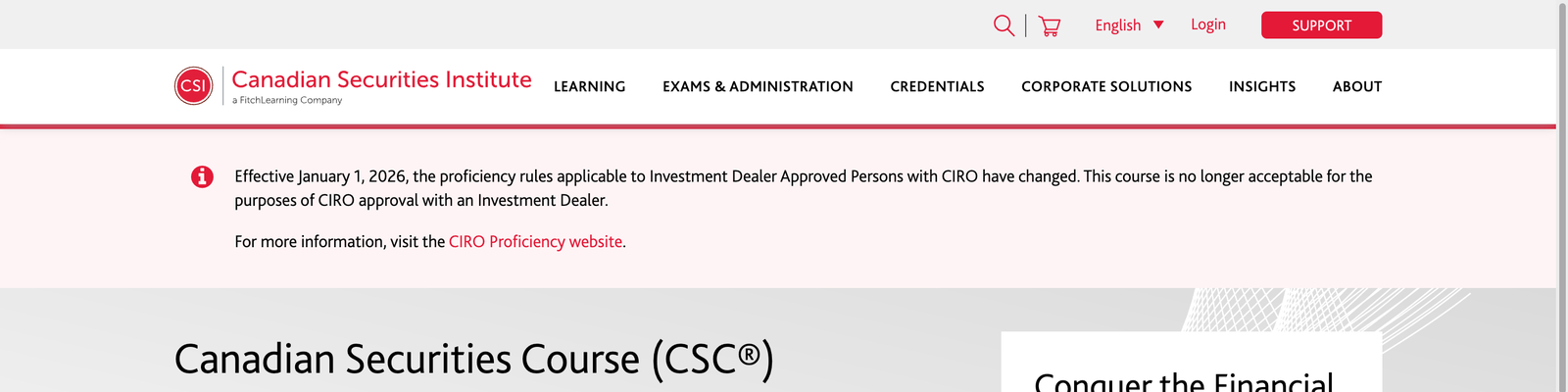
Screenshot of csi.ca's CSC course page, captured July 2026.
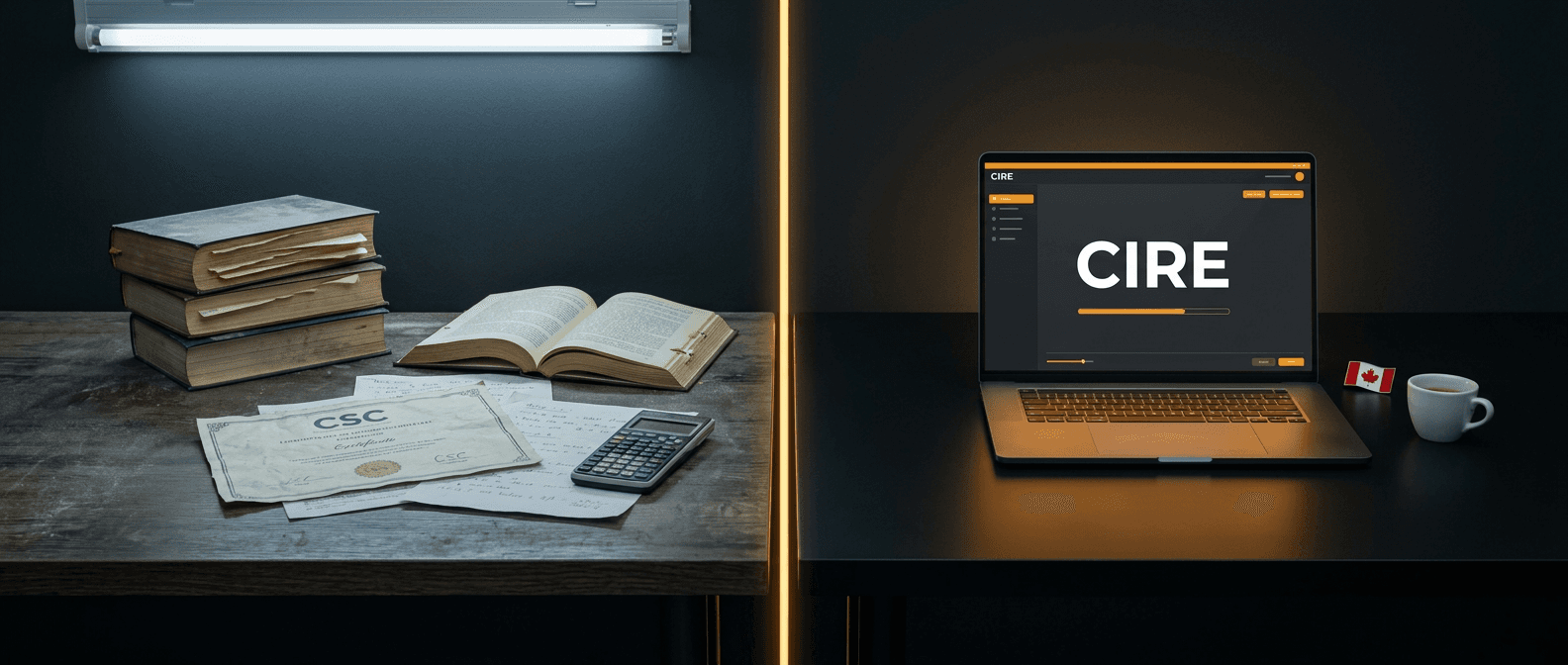
That's the Canadian Securities Institute telling you its flagship course no longer licenses you to work at an investment dealer. The front door moved. It now belongs to CIRO's own exams, starting with the CIRE.
The short version: The CSC is a self-study course from CSI — 135–200 study hours, two proctored 100-question exams, $998–$1,398. Until 2026 it was the licensing requirement for investment representatives. It was replaced by the CIRE: one 110-question exam, $475, no mandatory coursework. If your goal is a securities license at a Canadian investment dealer, the CIRE is your path — not the CSC. (One exception: a transition window for people who enrolled before 2026 — details below.)
Everything below is the long version: what the course was, what replaced it, and what to do depending on where the change caught you.
What is the CSC — and what did it used to get you?
The Canadian Securities Course is CSI's foundational financial-markets course: Canadian markets, the economy, investment products, mutual funds, taxation, regulation. Per CSI's own exam page, it's built for 135–200 hours of study inside a one-year enrolment window, assessed through two proctored exams — 100 multiple-choice questions each, two hours each, with a 60% passing grade per exam and three attempts allowed per exam (full format and official topic weightings in our CSC exam guide). The licensing-stream editions currently sell for $998 to $1,398, depending on the bundle.
None of that is what made the CSC famous. What made it famous was its regulatory role: completing the CSC (typically with the Conduct and Practices Handbook) was how you qualified for registration as an investment representative at an IIROC — later CIRO — dealer. The course completion certificate was the credential. That's the role that ended on January 1, 2026.
The course itself still exists. CSI continues to sell it, some employers still value it as training, and there's a separate "CSC for Investors" edition ($550) for people who want the education without a career attached. What changed is what it counts for.
What replaced it: one exam instead of a course
CIRO — the regulator formed from the merger of IIROC and the MFDA — replaced its course-based proficiency model with an exam-based one. It no longer requires any third-party course. It administers its own licensing exams, and how you prepare is entirely up to you.
For the investment-dealer stream, the entry requirement is now the Canadian Investment Regulatory Exam (CIRE): 110 multiple-choice questions in 120 minutes, $475 for a first attempt ($300 for a retake), up to three attempts per 12-month enrollment. Depending on your role, a second exam follows — the Retail Securities Exam for advisors serving retail clients, or the Institutional Securities Exam for institutional work.
Do the arithmetic the old path never asked you to do. The CSC route meant $998–$1,398 to a course provider, 135–200 hours of prescribed study, and two exams — for a certificate that was the credential. The new route is a single $475 exam where the exam is the credential and preparation is an open market: the official syllabus is free, and you can study however works for you. The industry's entry cost dropped by more than half; what rose is the weight on the exam itself.
Do you still need the CSC? It depends on your situation
- You're starting from scratch today and want to become an investment representative or advisor at a CIRO dealer. No — and this isn't our opinion, it's CSI's own notice. Your path is the CIRE, then the RSE or ISE depending on the role. Start with what the CIRE covers.
- You enrolled in the CSC before January 1, 2026. You may not need to switch paths at all. CIRO's transition provisions (Rule 2629(1), summarized in its New Candidates FAQ) allow a pre-2026 enrolment to still be recognized — if you complete the course and its exams before January 1, 2027, you'd have met the old proficiency requirements for the category you're seeking, and a sponsoring dealer submits your approval application before January 1, 2027. Every one of those conditions matters — and the dealer's filing deadline is the easiest to overlook — so talk to your sponsoring firm before deciding. If you can't realistically clear all three, the CIRE path is your fallback.
- You started (or are starting) the CSC after January 1, 2026. Then the transition window doesn't apply, and finishing won't license you at an investment dealer. The honest accounting: the money is spent either way; the knowledge transfers. The CSC's coverage overlaps heavily with what the CIRE tests — take a free readiness check to see exactly how much carried over. Many mid-CSC candidates are further ahead than they think.
- An employer, job posting, or program says "CSC required." That requirement is theirs, not CIRO's — and many internal checklists were written before 2026. Worth a direct question to HR: "Is this still current, given CIRO's new proficiency rules?" You may save yourself $1,000 and up to 200 hours.
- You want financial education, not a license. Then the CSC remains a legitimate course, and CSI's investor edition exists for exactly this. The only mistake is paying licensing-stream prices believing it's still the ticket into the industry.
CSC vs CIRE at a glance
| CSC (old path) | CIRE (current path) | |
|---|---|---|
| What it is | Course + certificate from CSI | CIRO's own licensing exam |
| Licenses you at an investment dealer | No for new enrolments — pre-2026 enrollees have a transition window to Jan 1, 2027 | Yes — it's the entry exam |
| Cost | $998–$1,398 | $475 first attempt, $300 retake |
| Exams | Two — 100 questions, 2 hours each | One — 110 questions, 120 minutes |
| Pass mark | 60% per exam (published) | Not published — set psychometrically per exam version |
| Mandatory coursework | The course is the product | None — prepare however you want |
| Study time | 135–200 hours (CSI's estimate) | Your call — most candidates report 6–8 focused weeks |
CSC figures from CSI's course and exam pages, July 2026; CIRE figures from CIRO's exam hub.
Your path from here
If the license is the goal, the 2026 route has three steps:
- Learn the new exam's shape. What is CIRE? covers format and stakes; the nine elements show what's actually tested, element by element, with official weights.
- Find your real starting point. The free CIRE readiness check is 25 blueprint-weighted questions, about 15 minutes, no signup — scored element by element. If you have CSC or industry background, this is where you find out how much transfers.
- Practice against your gaps, not the average. What the data says about where candidates actually lose points is its own story — the feared topics aren't the dangerous ones — and we wrote it up from 14,000+ real practice answers in Is the CIRE Hard? When you're ready to drill: EnCiro's CIRE prep is 12,000+ exam-style questions with explanations, tracked by element. The week-by-week plan lives in How to Pass the CIRE.
FAQ
Is the Canadian Securities Course still required in 2026?
Not for CIRO licensing at an investment dealer. CSI's own course page states that effective January 1, 2026, the CSC "is no longer acceptable for the purposes of CIRO approval with an Investment Dealer." The requirement for that stream is now CIRO's own exam, the CIRE. One exception: candidates who enrolled in the CSC before January 1, 2026 may still have it recognized under CIRO's transition provisions, if they complete it and their dealer files for approval before January 1, 2027.
What replaced the Canadian Securities Course?
The Canadian Investment Regulatory Exam (CIRE) — a 110-question, 120-minute multiple-choice exam under CIRO's exam-based proficiency model, with no mandatory prerequisite courses. Role-specific exams follow it: the RSE for retail advisors, the ISE for institutional representatives.
How much does the CSC cost?
Per CSI's enrolment page as of July 2026: $998 for the online edition, $1,098 with a hard-copy textbook, $1,398 for the value-pack bundle, and $550 for the non-licensing "CSC for Investors" edition. The exam that replaced it for licensing, the CIRE, costs $475 per attempt.
How long does the CSC take?
CSI estimates 135–200 hours of study, with a one-year enrolment period and two proctored exams (100 questions, two hours, 60% to pass each). For comparison, most CIRE candidates report 6–8 focused weeks of preparation for its single exam.
I'm halfway through the CSC. Should I finish it?
It depends on when you enrolled. If you enrolled before January 1, 2026, CIRO's transition provisions can still recognize the course — but only if you finish the course and exams before January 1, 2027, you'd meet the pre-2026 requirements for your category, and a sponsoring dealer files your approval application before that same deadline. Talk to your dealer about whether you can clear all three. If you enrolled after January 1, 2026 (or can't meet the conditions), finishing won't license you at an investment dealer — your path is the CIRE, and your CSC studying transfers as a head start.
What replaced the CSC?
The CIRE, CIRO's Canadian Investment Regulatory Exam. The CSC was 135-200 study hours and two proctored 100-question exams at $998-$1,398. The CIRE is a single 110-question exam at $475 with no mandatory coursework.
What if I enrolled in the CSC before 2026?
A pre-2026 enrolment can still be recognised under CIRO's transition provisions (Rule 2629(1)), but three conditions all have to hold: you complete the course and its exams before January 1, 2027, you would have met the pre-2026 proficiency requirements for your category, and a sponsoring dealer files your approval application before that same date. The dealer's filing deadline is the one most often overlooked. Speak to your sponsoring firm before deciding.
My employer says CSC required. Is that still correct?
That requirement is the employer's, not CIRO's, and many internal checklists were written before 2026. It is worth asking HR directly whether it is still current given CIRO's new proficiency rules. You may save roughly $1,000 and up to 200 hours. If you want financial education rather than a licence, the CSC remains a legitimate course.
Sources
- CSI — Canadian Securities Course — the January 1, 2026 notice and enrolment pricing (accessed July 2026)
- CSI — CSC Exam & Credits — exam format, study hours, enrolment period, passing grade
- CIRO — CIRE Exam Hub — exam format, fees, attempts
- CIRO — Proficiency for New Candidates — the exam-based proficiency model and the Rule 2629(1) transition conditions for pre-2026 CSI enrolments