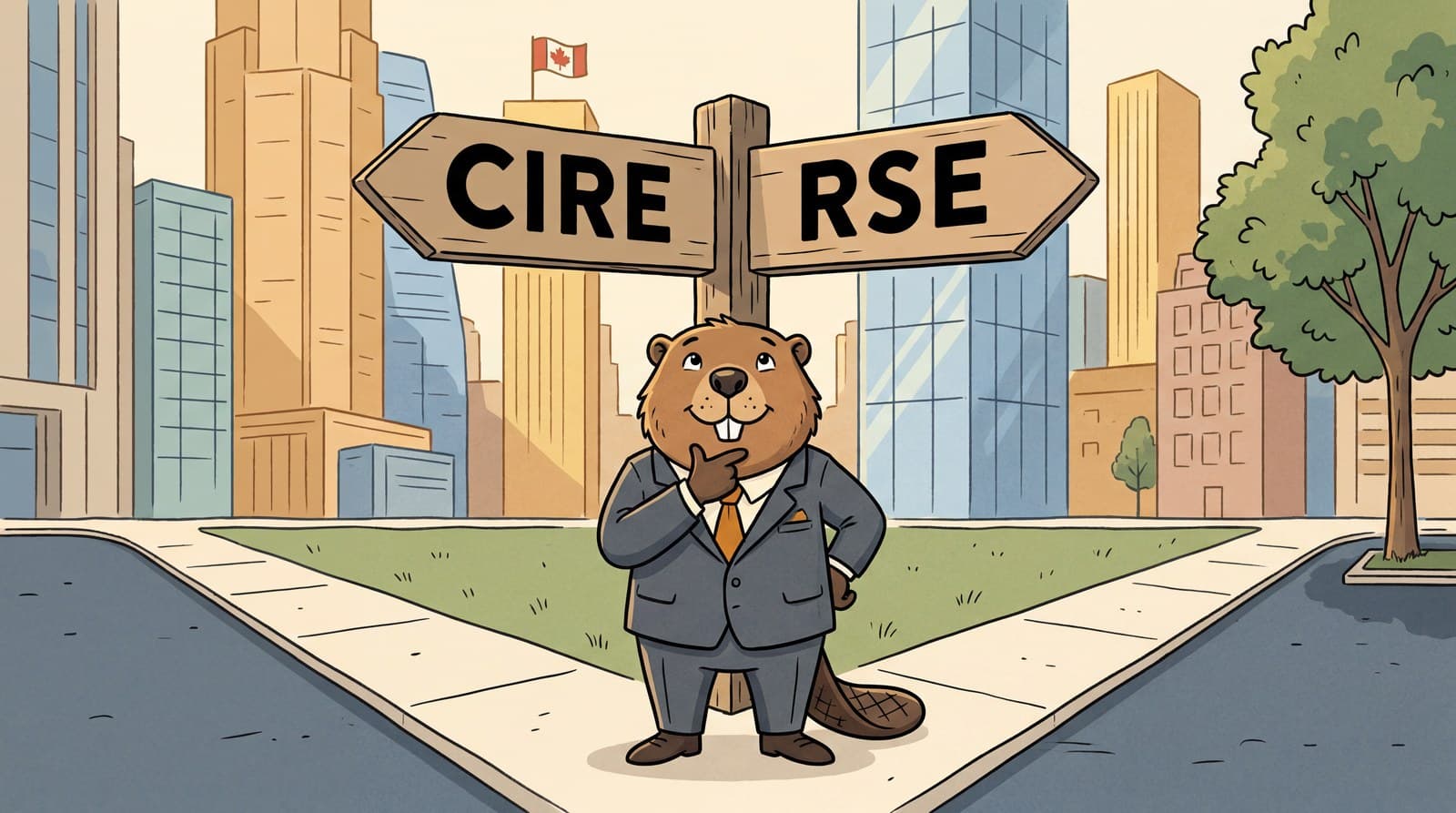
If you're here, you're probably trying to answer one question: do you need the CIRE, the RSE, or both? It's a completely fair thing to be unsure about. CIRO rebuilt the whole licensing system in 2026, the exam names are new, and the official pages tend to assume you already understand how the pieces fit together. Most people don't, at first. That's okay.
So let's make it simple.
The two exams unlock two different things. The CIRE lets you buy and sell securities for clients — take their orders and carry them out. The RSE, written on top of the CIRE, lets you advise them: recommend investments, build a portfolio, and guide the decisions they're nervous about.
For most people getting into this field, advising clients is the whole point — so you'll likely need both, and there's a specific order to take them in. If you only ever plan to execute orders, the CIRE on its own is enough.
Here's exactly who needs which, and why — in plain language, the way someone who's done it would actually explain it to you.
Why are there two exams now?
For decades, getting licensed in Canada meant courses. The Canadian Securities Course. The Conduct and Practices Handbook. Months of reading and a few thousand dollars before you could so much as apply for a job. On January 1, 2026, CIRO threw that whole model out.
What replaced it: nine exams, zero mandatory courses. You don't enrol in anything. You sit an exam and prove you know the material — and how you got that knowledge is nobody's business but yours.
The CIRE is the front door almost everyone walks through. Most of the other exams are role-specific and stack on top of it, depending on what you actually want to do for a living — the RSE is the one for advising retail clients. (A couple of the senior exams, like the ones for CFOs and directors, sit outside that path and don't require the CIRE first.)
Which is why comparing them head-to-head is a little misleading. The two exams stack rather than compete: the CIRE is the foundation almost everyone starts with, and for many people the RSE is the next step up from there. Getting that relationship wrong is what costs people months — and sometimes a job offer — so it's worth taking a minute to get it straight.
What the CIRE actually is
The CIRE — the Canadian Investment Regulatory Exam — is the foundation. It's the first of the nine exams, and you can't register with a CIRO firm without it.
On its own, the CIRE lets you register as an Investment Representative (IR). As an IR, you can carry out trades for clients: if someone tells you to buy 100 shares of a company, you place that order. What you can't do yet is give advice. If that same person asks whether buying those shares is actually a good idea, you have to tell them you're not able to weigh in — that's not you being unhelpful, it's simply where an IR's licence stops.
The basics: 110 questions, 2 hours, $475, scored pass/fail — CIRO doesn't publish a numeric pass mark, so there's no "you missed it by 2%," just a verdict. The material is broad — conduct, the rules, how Canadian markets are put together. Think of it as the exam that proves you understand how the system works and how to operate inside it responsibly.
For some roles, that's genuinely all you need. But if you got into this to help people with their money — not just place their orders — the CIRE is only your first step.
What the RSE actually is
The RSE — the Retail Securities Exam — is what lets you actually advise people.
Once you've passed the CIRE, passing the RSE on top of it lets you register as a Registered Representative (RR) for retail clients. As an RR you do everything an IR does, plus the real heart of the job: you look at someone's full situation, recommend what makes sense for them, and stand behind it. The question you had to deflect as an IR — is this a good idea for me? — you can finally answer.
The basics: 120 questions, 3 hours, $475, scored the same way — pass/fail, no published mark. You'll already have the CIRE, since it comes first. The RSE asks more of you than the CIRE does: it wants to know whether you can sit with a real person's situation and make a call that's genuinely right for them. That means knowing your client, judging what's suitable, understanding the products well enough to choose between them, and building a portfolio that actually fits the person's life.
Its biggest single section, Know-Your-Client & Suitability, makes up 22.5% of the exam — more than a fifth, on its own. Which makes sense when you think about it: before you can responsibly recommend anything to someone, you have to really understand them first.
The real difference: rules vs. judgment
The simplest way to think about it:
- CIRE — can this trade be done? (Rules, conduct, regulation.)
- RSE — should this person do it? (Judgment, suitability, advice.)
The CIRE asks whether you know the rulebook. The RSE asks whether you can read a nervous 58-year-old with their retirement on the line and make the call that's actually right for them.
Here's a real RSE question. There's no rule to look up — you have to read the situation and make a call for one particular person:
A mid-career professional wants to actively rebalance their portfolio quarterly and frequently pivot between sectors based on economic data. Under IDPC Rule 3211 (Account Appropriateness), which model is generally most suitable for this client?
The rules still matter here — they tell you which accounts are even permissible. But they stop short of the actual decision. Choosing the right one for this client means reading their situation and weighing the trade-offs yourself. That extra step — judgment on top of the rules — is what the RSE tests and the CIRE doesn't.
CIRE vs RSE, side by side
| CIRE | RSE | |
|---|---|---|
| Stands for | Canadian Investment Regulatory Exam | Retail Securities Exam |
| Qualifies you as | Investment Representative (IR) | Registered Representative (RR), retail |
| Can you advise clients? | No — trade only | Yes |
| Role in the model | The entry gate (first of nine) | Role exam — requires CIRE first |
| What it tests | Regulatory framework, conduct, rules | KYC, suitability, products, portfolio judgment |
| Questions | 110 | 120 |
| Time | 2 hours | 3 hours |
| Scoring | Pass/fail (no published mark) | Pass/fail (no published mark) |
| Cost | $475 | $475 |
So which one do you actually need?
Here's the short version — find the one that sounds like you:
- You want to execute trades, not give advice (order-execution desks, certain discount-brokerage roles) → CIRE. One exam. Done.
- You want to advise retail clients — build a book, make recommendations, manage relationships → CIRE + RSE. This is the path nearly everyone in a client-facing advisory role is on.
- You want to advise institutional clients (pension funds, asset managers, the big-money desks) → CIRE + ISE (the Institutional Securities Exam) instead of the RSE — a different exam for a different kind of client. More on the ISE here.
For most people reading this, the goal is to advise clients — to be the person they actually turn to for guidance, not just someone who executes their orders. If that's you, you'll need both exams: the CIRE to get registered, and the RSE to do the part of the job you got into this for.
Do you need both? And in what order?
Yes — and the order matters.
The CIRE always comes first. It's a hard prerequisite: you can't book the RSE until you've passed it. So the path is:
- Pass the CIRE → you're an IR (you can trade).
- Pass the RSE → you're an RR (you can advise).
One genuinely useful change in 2026: you can write the CIRE without firm sponsorship. You no longer need a dealer to sponsor your registration before you're allowed to attempt the exam. Pass the CIRE on your own, show up to interviews with proof of competency already in hand, and you've quietly shifted the leverage in your favour.
Is the RSE harder than the CIRE?
Honestly, "harder" is the wrong word — the two are hard in different ways, and that's what trips people up.
The CIRE covers a lot of ground. There's a real volume of regulatory material, and it rewards staying organized and knowing the conduct rules cold. The RSE is narrower but goes deeper. You'll see fewer questions that simply ask you to recall a rule, and more that drop you into a client's situation and ask what you'd actually do. If you're someone who memorizes well but tenses up on a judgment call, the RSE is where you'll feel it.
The good news is the weighting tells you where to spend your time. KYC & Suitability is 22.5% of the RSE. Get that element airtight and you've covered nearly a quarter of the exam before touching anything else. The full RSE breakdown is here.
What happened to the CSC?
If you've been around this world a while, you're probably wondering where the Canadian Securities Course went. Short answer: it's gone as a licensing requirement, and the CIRE took over its job as the entry gate. The 2026 model is exam-based — no mandatory courses, the CSC included. So if someone tells you to "just do the CSC," they're working off an old map. (The full CIRE/CSC story is here.)
The RSE didn't replace the CSC either. It's a genuinely new, advice-level exam — there was nothing quite like it in the old course-based system — so if you're trying to map it onto something you studied years ago, you won't find a match.
How to pass them the first time
Both exams are scored pass/fail, both cost $475, and both charge you $300 to sit again if you miss. Retakes are slow and expensive. The whole game is passing on the first attempt.
That's the reason we built EnCiro. There's a separate, full prep platform for each exam — not one shared question bank with a filter on it:
- CIRE prep — 12,000+ questions, full learning centre, AI tutor, custom mocks.
- RSE prep — 8,000+ questions across all 9 elements, weighted toward what's actually on the exam, plus a mock builder and AI tutor.
Start free, run a few sample questions, and see whether the trade-vs-advice distinction clicks before you spend a cent.
FAQ
Do I need both the CIRE and the RSE?
Only if you want to *advise* retail clients. To register as a Registered Representative (RR) you need both — CIRE plus the RSE. If you only want to execute trades (Investment Representative), the CIRE alone is enough.
Can I take the RSE without the CIRE?
No. The CIRE is a prerequisite — you have to pass it before you can book the RSE.
What's the difference between an IR and an RR?
An Investment Representative (IR) can trade but not advise — they execute client instructions. A Registered Representative (RR) can do both: trade *and* advise. The RSE is what moves you from IR to retail RR.
Is the RSE harder than the CIRE?
They're hard in different ways. The CIRE is broad and regulation-heavy, while the RSE is narrower but leans on applied judgment — suitability and real client scenarios. If memorization is your strength, the CIRE may feel more comfortable; if you think well on your feet, you might find the RSE easier.
Does the RSE replace the CSC?
No. The CIRE took over the CSC's role as the entry-level requirement. The RSE is a new, advice-level exam with no direct equivalent in the old course-based system.
How much do the CIRE and RSE cost?
$475 each for a first attempt, $300 for each retake — standard CIRO proficiency-exam pricing.