The CSC is dead.
On January 1, 2026, Canada killed the Canadian Securities Course as a licensing requirement. The Conduct and Practices Handbook too. Thousands of candidates spent years and thousands of dollars on those courses. Now? A single $475 exam with no mandatory coursework.
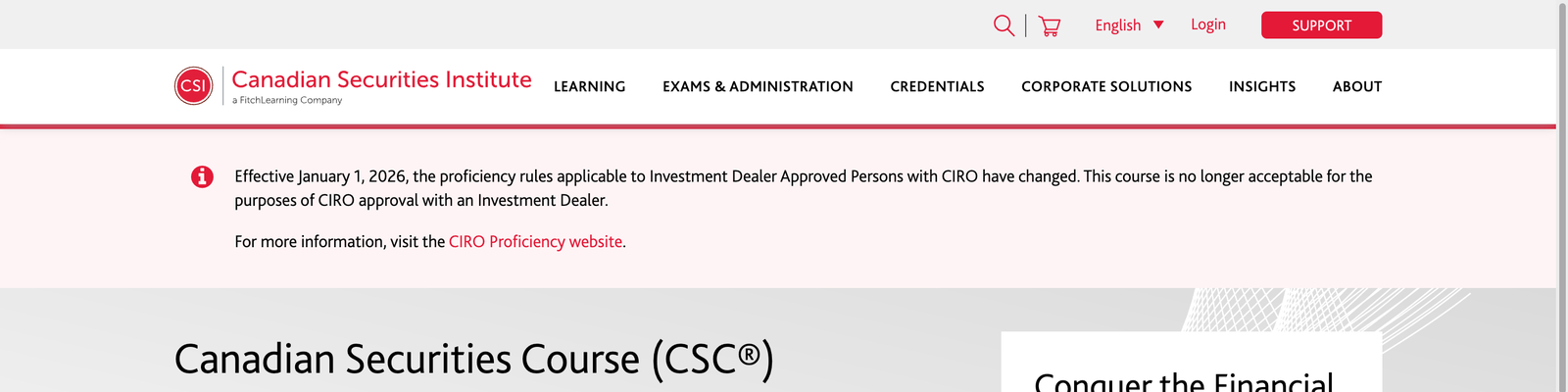
Don't take our word for it — this is CSI's own notice on the CSC course page (captured July 2026).
If you're mid-CSC wondering whether to finish, staring at CIRO's website trying to figure out what "CIRE" even means, or debating whether this career path just got easier or harder—this is for you. (And if your question is about the course itself — what the CSC still costs and whether anyone should still take it — we cover that in Canadian Securities Course in 2026.)
Quick facts: CIRE stands for Canadian Investment Regulatory Exam. 110 questions, 2 hours, $475. Replaced the CSC + CPH requirement on January 1, 2026. No mandatory courses—study however you want.
What is CIRE? The Basics
CIRE stands for Canadian Investment Regulatory Exam. It's administered by CIRO (the Canadian Investment Regulatory Organization, formed from the merger of IIROC and MFDA)—and it's a complete departure from how Canada has credentialed investment professionals for decades.
The old model was course-centric. You enrolled in the CSC, worked through months of material, wrote the exam, then repeated the process with the CPH. At CSI's current list prices that is $1,639 to $2,079 and 175 to 255 hours of prescribed study before you could even apply for registration.
The new model is assessment-centric. CIRO's position: if you can demonstrate competency, how you acquired that competency shouldn't matter. Maybe you learned through a formal course. Maybe you studied independently. Maybe you've been working in a related role for years. The exam doesn't care. It only cares whether you know the material.
This affects every CIRO member firm across Canada—from the big banks to boutique dealers. Every new investment representative registration now flows through CIRE.
Who Actually Needs to Take the CIRE Exam?
This is where confusion sets in. The answer depends on what role you want.
Investment Representatives (IR) execute trades on client instructions. They take orders and process them. They cannot provide advice about what clients should buy or sell. For this role, CIRE alone is sufficient.
Registered Representatives (RR) do everything an IR does, plus they can actually advise clients. They analyze portfolios, make recommendations, and guide investment decisions. For this role, you need CIRE and the Retail Securities Exam (RSE).
The distinction matters enormously for your career. An IR handles execution—clients tell you what they want, and you process the trade. An RR builds relationships, grows a client book, gives advice, and shapes portfolios. The earning potential is different, and so is the career trajectory.
If you want to advise clients—help them build wealth, not just process their trades—you need the RR designation. That means a second exam after the CIRE. Retail clients route you to the RSE. Institutional desks route you to the Institutional Securities Exam (ISE). Both treat the CIRE as a hard prerequisite, so you write it first either way.
One notable change in 2026: you can now write the CIRE exam without firm sponsorship. Previously, you needed a CIRO member firm to sponsor your registration before you could even attempt the exams. Now you can pass CIRE first, then approach firms with proof of competency already in hand. This shifts the power dynamic slightly toward candidates.
The CIRE Exam Format: What to Expect on Test Day
The format is simple:
- 110 multiple-choice questions
- 2 hours to complete
- Cost: $475 for first attempt, $300 for retakes
- Delivery: In-person at testing centers or remote proctoring
You get three attempts within a 12-month enrollment period. After three failures, there's a mandatory 6-month cooling-off period before you can re-enroll. CIRO doesn't publish pass rates. Industry estimates put first-time passes around 65-75%, though this is anecdotal.
Remote proctoring uses the same security protocols as in-person testing: identity verification, screen monitoring, and AI-flagged behavior review. Some candidates prefer the structure of a testing center. Others prefer the comfort of home. Both are equally valid for registration purposes.
Two hours for 110 questions gives you roughly 65 seconds each — which evaporates once you realize each scenario is 50-100 words before you even see the answer options. Reading speed matters as much as knowledge.
What the CIRE Exam Tests: Breaking Down the 9 Elements
CIRO structures the exam around nine competency elements. Here's the complete breakdown:
| Element | Topic | Questions | Weight |
|---|---|---|---|
| 1 | Regulatory Framework | 11 | 10% |
| 2 | Prospective Client Relationships | 11 | 10% |
| 3 | Scope of Client Relationship (KYC/Suitability) | 17 | 15.5% |
| 4 | Client Complaints | 6 | 5.5% |
| 5 | Market & Company Analysis | 9 | 8.2% |
| 6 | Market Integrity | 13 | 11.8% |
| 7 | Securities & Products | 21 | 19.1% |
| 8 | Derivatives | 6 | 5.5% |
| 9 | Ethics & Conflicts | 16 | 14.5% |
If you're strategic about study time, focus on Elements 3, 7, and 9. Together they represent 49% of the exam—nearly half your score from three topics.
Element 3 (KYC/Suitability) is where most candidates struggle. It's not enough to know what KYC stands for. You need to analyze scenarios where the pieces don't fit: a client says they want growth but also mentions retiring in two years. Another wants "safe investments" but keeps asking about crypto ETFs. A third has outdated KYC on file and just inherited $500,000. What do you do? This is judgment work, not memorization. (The exam loves these. Get used to them.)
Element 7 (Securities & Products) tests your understanding of what you're actually selling. Equities, fixed income, mutual funds, ETFs, structured products. How they work. What risks they carry. When they're appropriate. When they're not. That last part is where the exam lives — matching the right product to the right client.
Element 9 (Ethics & Conflicts) examines your ability to recognize problematic situations before they become regulatory violations. Soft-dollar arrangements, referral fees, personal trading alongside client accounts, confidentiality obligations. The questions present gray areas where the "right" answer requires balancing competing interests. The answer is almost never "disclose and carry on" — CIRO's hierarchy is avoid first, address second, disclose last. Get that backwards and you'll lose points you didn't need to lose.
The remaining elements aren't unimportant, but they're smaller targets. Element 8 (Derivatives) only carries 6 questions. If you're time-constrained, that's not where you spend your weeks.
Why CIRO Replaced the CSC with CIRE
The old CSC model was comprehensive but inefficient. Candidates memorized bond pricing formulas they'd never use. They studied corporate finance theory disconnected from client service reality. The pass rates were high—too high, some argued, given the minimal relevance of much content.
CIRO's competency model focuses on what representatives actually do. The nine elements map to real job functions: opening accounts, collecting KYC information, assessing suitability, handling complaints, maintaining market integrity. The exam questions present scenarios pulled from actual compliance situations.
The shift in one sentence: the exam puts you in a messy client situation and asks what you'd actually do.
This has implications for how you study. Reading a textbook cover-to-cover won't help as much as practicing scenario analysis. The exam doesn't ask "Define suitability." It presents a client situation with conflicting elements and asks what you should do. That's a different skill.
CSC vs CIRE: Do I Still Need the Canadian Securities Course?
If you hold CSC and CPH and you were already approved before January 1, 2026, you keep your approval and you do not need the CIRE. CIRO deems you to have continued in the same role as long as your approval has not ceased for more than 180 days. The relief attaches to the approval, not to the certificates.
If you hold CSC and CPH but were never approved, the certificates on their own do not exempt you. Your route is CIRO's transition provision in section 2629, and it has conditions and a deadline — we walk through all four in the CPH guide. Read them before you assume you are covered.
If you started the CSC and haven't finished, there is no partial credit. Section 2629 is all-or-nothing: you must have enrolled before January 1, 2026, complete the course and its exams before January 1, 2027, end up meeting the pre-2026 requirements for the category you want, and have a sponsoring dealer file your approval application before January 1, 2027. That last one is not in your hands, so ask your firm now.
If you're starting fresh in 2026, skip the CSC. At CSI's current list prices the CSC and CPH together run $1,639 to $2,079 and 175 to 255 hours of prescribed study, and none of it is a regulatory requirement any more. Some people still take the CSC for the educational depth, which is a fair personal choice.
How to Start Preparing for CIRE
That's the exam. But knowing about it won't help you pass it. The competency-based format punishes traditional study methods — reading textbooks, memorizing definitions. What actually works is scenario practice, red-flag recognition, and timed judgment calls.
Which study resources actually work. Which waste your time. How to build a study plan that matches the exam's reality — not the fantasy that reading a textbook twice will get you a passing score.
FAQ
What does CIRE stand for?
CIRE stands for the Canadian Investment Regulatory Exam. It is administered by CIRO, the Canadian Investment Regulatory Organization formed from the merger of IIROC and the MFDA. It replaced the CSC and CPH as the licensing requirement for investment representatives on January 1, 2026.
Is CIRE a certification or a course?
Neither. CIRE is a single exam with no mandatory coursework. The old model was course-centric: you enrolled in the CSC, worked through months of material, then repeated it with the CPH. CIRO's new model is assessment-centric — it does not care how you acquired the competency, only whether you can demonstrate it. You can study however you like.
How much does the CIRE exam cost and how long is it?
$475 for a first attempt and $300 for a retake. The exam is 110 multiple-choice questions in 2 hours, delivered either in person at a testing centre or by remote proctoring.
What replaced the Canadian Securities Course?
The CIRE replaced both the CSC and the Conduct and Practices Handbook as of January 1, 2026. CSI's own course page confirms the CSC is no longer acceptable for CIRO approval at an investment dealer. Where the old two-course path ran $1,639 to $2,079 and 175 to 255 hours at CSI's current list prices, the new one is a single $475 exam.
Who needs to take the CIRE exam?
Anyone registering as an investment representative with a CIRO member firm. Investment Representatives, who execute trades on client instructions and cannot give advice, need CIRE alone. Registered Representatives, who also advise clients and build portfolios, need CIRE plus the Retail Securities Exam (RSE).
Can I write the CIRE without a sponsoring firm?
Yes. As of 2026 you can sit the CIRE without firm sponsorship. Previously a CIRO member firm had to sponsor your registration before you could attempt the exams; now you can pass first and approach firms with proof of competency already in hand.