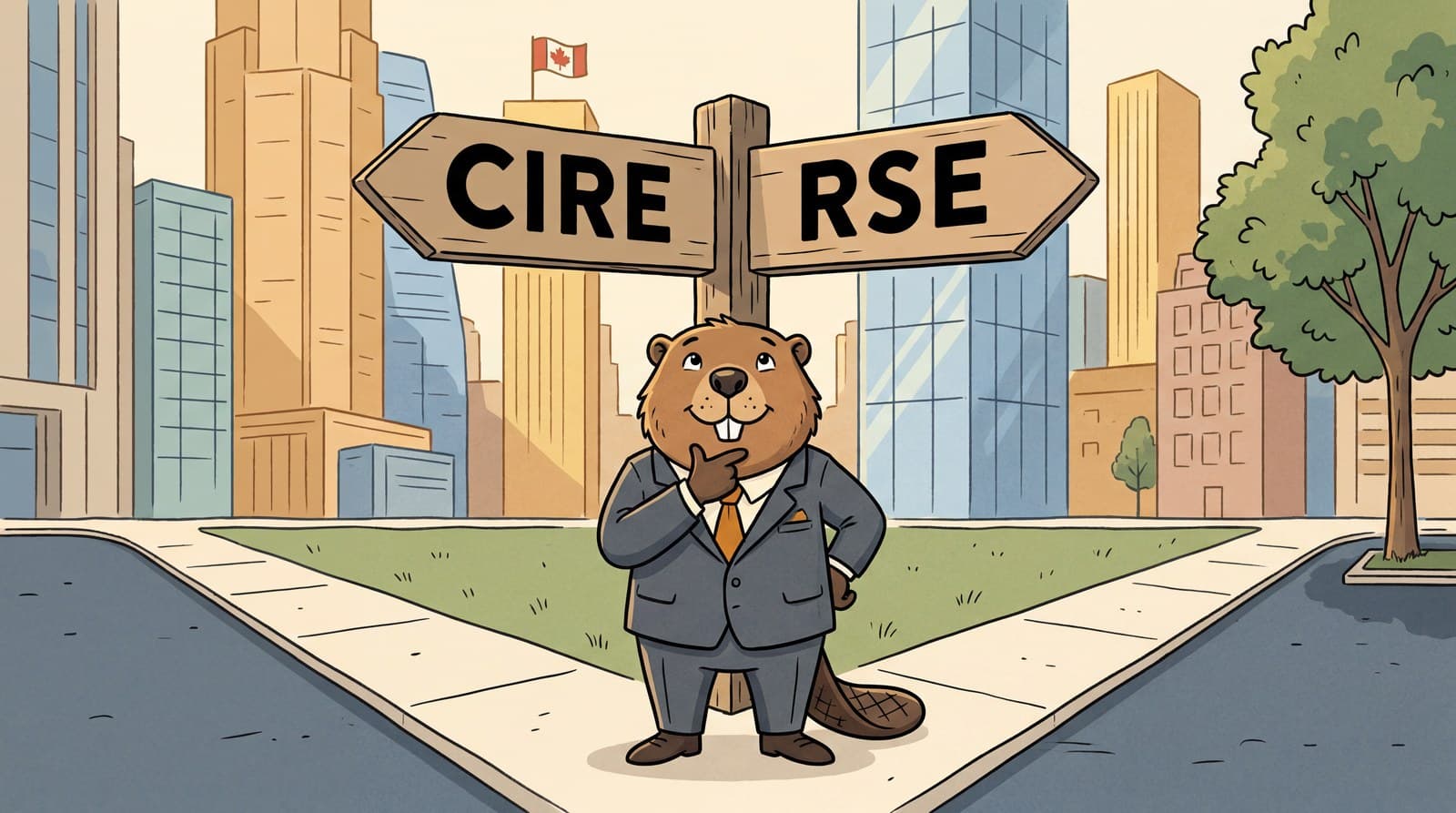

Pass the CIRE and CIRO's exam path forks: the Retail Securities Exam one way, the Institutional Securities Exam the other. They cost the same $475, run at the same 90-seconds-per-question pace, come from the same regulator — and are otherwise about as different as two securities exams can be.
Here's the part that should lower your blood pressure: this usually isn't your decision to make. It's your career's. The RSE licenses you to advise retail clients; the ISE licenses you to service institutional ones. Pick the desk, and the exam picks itself. What this post gives you is the honest side-by-side — format, content DNA, difficulty shape — so you know exactly what you're signing up for once the desk is chosen.
The short version: Advising individual investors (branch, wealth management, retail advisory) → CIRE + RSE. Servicing institutions (pension funds, hedge funds, corporate treasuries, trading desks) → CIRE + ISE. They're parallel tracks — you don't need both, there's no order between them, and neither is a stepping stone to the other. The RSE is a client-judgment exam; the ISE is an analysis-concentration exam.
The One-Question Decision
Who will be on the other side of your conversations?
- A person — someone with an RRSP, a retirement date, a risk profile, and feelings about market drops → RSE. This is the registration path for Registered Representatives serving retail clients.
- An institution — a pension fund with a liability schedule, a hedge fund needing prime brokerage, a corporate treasury moving size → ISE. This is the path for institutional Registered Representatives.
In practice, your sponsoring dealer settles this: firms register you in a category, and the category dictates the exam. If you've been hired onto a retail advisory team, the RSE-vs-ISE question is already answered. The people genuinely choosing are usually students and career-switchers — and for them, the exams themselves are a surprisingly honest preview of the two jobs.
Side by Side: The Format
| RSE | ISE | |
|---|---|---|
| Full name | Retail Securities Exam | Institutional Securities Exam |
| Questions | 120 | 100 |
| Duration | 3 hours | 2.5 hours |
| Pace | 90 seconds/question | 90 seconds/question |
| Elements | 9 | 7 |
| Heaviest element | KYC & suitability — 22.5% | Securities analysis & investment theory — 31% |
| Learning outcomes | 109 | 83 |
| Cost | $475 first attempt, $300 retake | $475 first attempt, $300 retake |
| Attempts | 3 per enrollment | 3 per enrollment |
| Prerequisite | CIRE | CIRE |
| Pass mark | Not published (psychometric) | Not published (psychometric) |
Identical pace, identical price, identical rules of engagement. The differences live entirely in what's being tested — and in how each exam distributes its weight.
What They Share
Roughly speaking, the middle of both exams covers the same securities backbone, because both roles need it:
- Fixed income and equities — features, risks, bond math (yields, duration, time value of money), prospectus requirements under NI 41-101 and the NI 45-106 exemptions. This is 22 of the RSE's 120 questions and 25 of the ISE's 100.
- Execution and market integrity — UMIR, best execution, abusive trading, gatekeeping, order types (both exams love iceberg orders).
- Conduct and conflicts — identifying, avoiding, addressing, disclosing; outside activities; personal financial dealings.
- Managed products — funds, ETFs, alternatives, and their fee structures.
If you've prepared for either exam, a meaningful share of the other's territory will look familiar — though often retagged to a different cognitive level and always recontextualized to the other client universe.
Where They Diverge: The Content DNA
Only on the RSE:
- The retail suitability machine — suitability determinations, triggering events, unsolicited orders, churning, the appropriateness-vs-suitability distinction
- Vulnerable-client protection — trusted contact persons, temporary holds, spotting diminished capacity and financial exploitation
- Behavioural finance — fifteen named biases your retail client will bring into your office
- Personal tax planning — FHSAs, RRSPs, RESPs, TFSAs, capital gains, dividend taxation, income splitting
- Portfolio recommendations and monitoring — building, justifying, and reporting on portfolios for households, with performance measures like Sharpe, Treynor, and Jensen
Only on the ISE:
- The institutional relationship stack — sell-side vs buy-side, trader types, prime brokerage, securities lending, direct electronic access, M&A advisory
- Institutional suitability boundaries — client sophistication assessments, which clients are exempt by status and which only by written waiver
- Takeover and disclosure law — NI 62-104 bid thresholds, public-company disclosure, SEDAR+ and SEDI
- Algorithmic trading — benefits and failure modes, flash crashes included
- Deeper AML — money-laundering stages, compliance programs, enterprise risk assessment
Read those two lists as job descriptions, because that's what they are. One exam trains a professional to protect and guide a person. The other trains one to operate precisely inside institutional market machinery.
Is the RSE or ISE Harder? Two Shapes of Hard
We've mapped both exams' difficulty in detail — the RSE here, the ISE here — but the shapes are easy to summarize:
The RSE spreads its weight across a client arc. KYC & suitability (22.5%), investment recommendations (11.7%), and monitoring (5.8%) put the client at the center of 40% of the paper. Of its 109 learning outcomes, 65 are tagged Apply or Analyze — and exactly one is tagged Remember. The difficulty is judgment: catching the unsuitable hold, the client's misconception, the bias in the story.
The ISE concentrates its weight in one place. Securities analysis & investment theory is 31 of 100 questions — the heaviest element anywhere in the CIRE–RSE–ISE path — and holds 9 of the exam's 16 Analyze-level outcomes. Zero of its 83 outcomes are tagged Remember. The difficulty is analysis: ratios, valuation, factor models, and regulatory thresholds where every wrong option is a true fact about a neighbouring rule.
Which is harder? Whichever one fights your natural grain. If client scenarios are your strength, the ISE's quantitative concentration is the steeper climb; if analysis is, the RSE's judgment calls are slipperier than any formula. The blueprints don't crown a winner — they describe two different jobs.
Decision Scenarios
- You're joining (or aiming for) a bank branch, wealth-management team, or retail brokerage. RSE — the material is your job.
- You're headed for a trading desk, institutional sales, or coverage of funds and treasuries. ISE — same logic, other branch.
- You're a student or career-switcher choosing between the two worlds. Scroll back to the two "only on" lists and notice which one you'd rather be tested on for a living. That instinct is career information.
- You're an Investment Representative (order execution only). Neither, yet — the CIRE alone covers IR registration. The fork only matters when you move into an advising or institutional RR role.
Do You Ever Need Both?
Almost never — only when a career genuinely crosses worlds, like moving from a retail desk to an institutional one, where the new registration category requires the ISE regardless of your RSE. Most people never take both.
Whichever side of the fork is yours, the preparation logic is identical — weight your hours by the published blueprint, drill scenarios over definitions, and book at 70%+ on mocks (your own safety margin; neither exam publishes a pass mark). We've written the full plans for each: How to Pass the RSE and How to Pass the ISE. And if you want a 15-minute calibration on where you stand today, the free readiness checks are here: RSE · ISE.
FAQ
What is the difference between the RSE and ISE?
Both are CIRO licensing exams taken after the CIRE, but for different registration paths: the RSE (120 questions, 3 hours) licenses Registered Representatives who advise retail clients; the ISE (100 questions, 2.5 hours) licenses those who service institutional clients like pension funds and hedge funds. The RSE centers on KYC, suitability, and client judgment; the ISE centers on securities analysis, institutional relationships, and market mechanics.
Is the RSE or ISE harder?
They're hard in different ways, per their own blueprints. The RSE spreads judgment-heavy questions across a client-relationship arc (40% of the paper); the ISE concentrates 31% of its marks in one quantitative-analytical element. Neither publishes a pass rate or pass mark. If client scenarios suit your strengths, the RSE will feel smoother; if analysis does, the ISE will.
Do I need both the RSE and ISE?
Almost never. They're parallel tracks after the CIRE — retail or institutional — and your registration category requires exactly one of them. You'd only take both if your career moves between the retail and institutional worlds.
Can I take the ISE without the RSE (or vice versa)?
Yes. Neither exam is a prerequisite for the other; both require only the CIRE first. Choose based on your registration category — your sponsoring dealer will confirm which one your role needs.
Which should I take first, RSE or ISE?
There's no "first" — they're alternatives, not a sequence. Take the one your job requires. If you're choosing a career direction rather than an exam, decide whether you want to advise individual investors (RSE path) or service institutions (ISE path), and the exam follows.
Sources
- CIRO — Retail Securities Exam — official RSE syllabus, weightings, and learning outcomes
- CIRO — Institutional Securities Exam — official ISE syllabus, weightings, and learning outcomes
- CIRO — Proficiency for New Candidates — registration categories, fees, and enrollment