
Go to CIRO's CIRE page and try to register. You'll find a syllabus PDF, a practice exam PDF, a study guide PDF, and a sidebar linking to eleven other pages. What you won't find is a clear way to actually sign up. The enrollment link lives inside a collapsed FAQ on a completely different page.
That's because CIRO doesn't run exam registration. They outsourced it to Fitch Learning, which — for reasons known only to Fitch Learning — split the process across two separate portals. You pay on one website. You schedule your exam on a different website. Different URLs, different logins. It's the kind of UX that makes you wonder if anyone involved has ever registered for anything online before.
This guide exists so that process takes you twenty minutes instead of an afternoon.
The short version: Enrollment Portal (pay $475) → get credentials → Candidate Portal (schedule exam) → show up → 110 questions, 2 hours. That's it.
(If you're not sure what CIRE even is or whether you need it, start here.)
Before You Start: The Eligibility Checkbox
Somewhere in the enrollment flow, you'll hit an eligibility attestation. It sounds intimidating. It's a checkbox. You must be the age of majority in your province, and you're confirming one of these:
- You currently work at a CIRO Dealer Member firm, or
- You plan to apply to one within 12 months, or
- You're taking CIRE as a prerequisite for another CIRO exam (the RSE or the ISE)
That's the whole bar. No sponsorship letter. No employer verification. Just a checkbox.
This is a meaningful change from the old regime. Under the CSC model, you generally needed firm sponsorship before you could attempt the exam. CIRO's new proficiency model flipped that — you can now pass the exam first, then approach firms with proof of competency in hand. The power dynamic shifted.
You also don't need to complete any courses first. The Enrollment Portal itself states it plainly: "preparatory courses are not required or provided." No CSC. No CPH. No mandatory anything. Study however you want.
One group that can't enroll: education providers. If you run a prep company, CIRO doesn't want you reverse-engineering their exam by sitting it yourself. (We at EnCiro build practice questions from the published syllabus and regulatory source material — we haven't seen the actual exam either.)
Step 1: The Enrollment Portal — Where You Pay
This is the portal that actually looks like a registration page: portal.fitchlearning.ca/2/CiroCandidateEnrollment/exams/
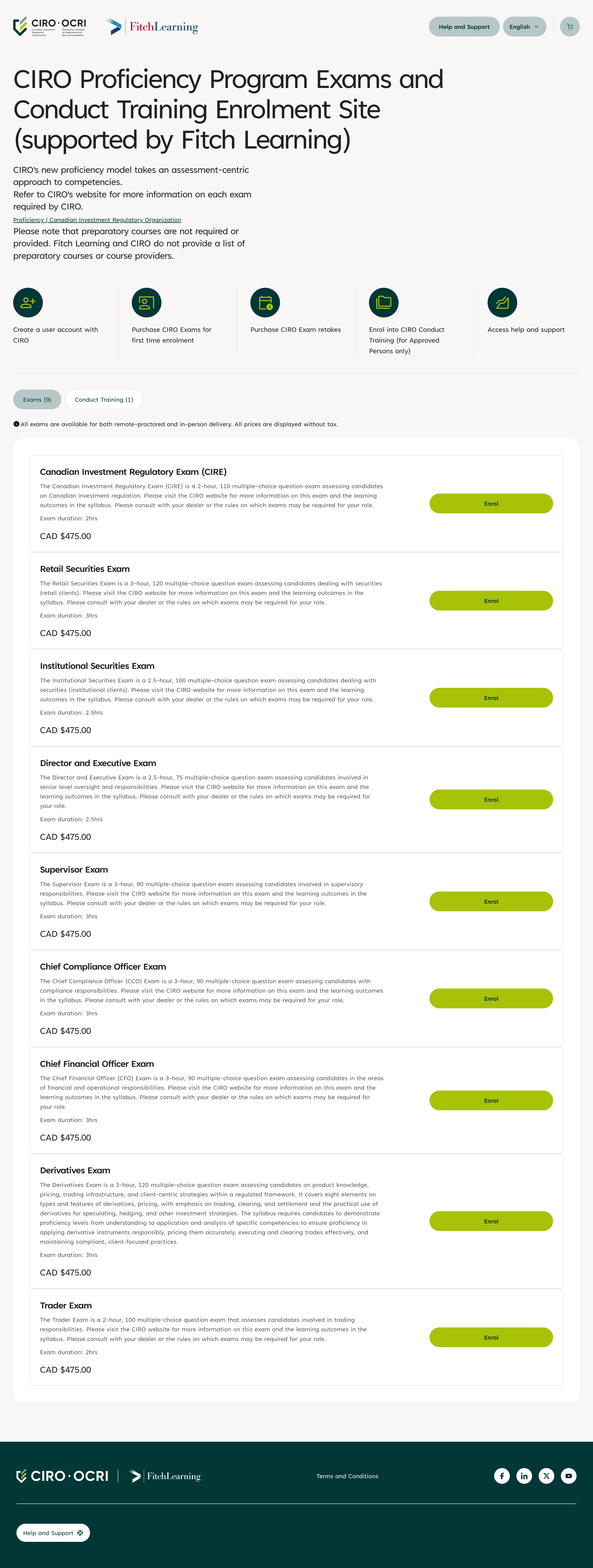
You'll see all nine CIRO proficiency exams listed — CIRE, Retail Securities, Institutional Securities, Director & Executive, Supervisor, CCO, CFO, Derivatives, and Trader. Every single one: $475 CAD. Flat pricing across the board, whether you're writing a two-hour exam or a three-hour one. Anyway:
-
Create an account. Your name must exactly match the government-issued photo ID you'll present on exam day. Not your nickname. Not a shortened version. If your passport says "Rajesh" and you register as "Raj," the proctor will turn you away and you'll have burned an attempt. Get this right the first time.
-
Select "Canadian Investment Regulatory Exam (CIRE)" and click Enrol.
-
Pay $475 CAD + applicable tax. Credit card only — no e-transfer, no invoice, no "bill my firm" option. If your employer is covering it, congratulations, you're floating them a loan until they reimburse you.
-
Complete the eligibility attestation.
After payment clears, you get a confirmation email with login credentials for the other portal — the Candidate Portal. This is the part that breaks people's brains. You just paid $475 on one website. Now you need to go to a different website to actually book the thing you paid for.
That confirmation email has your Candidate Portal credentials in it. Don't delete it. Don't let it go to spam. You need it for the next step.
Refund Policy
Per the Fees, Payments and Refunds Policy: you've got 30 days to get a refund, minus a $75 admin fee. After day 30, that $475 is Fitch Learning's forever. And a refund doesn't just cancel one attempt — it kills your entire enrollment period. You can't partially back out.
Step 2: The Candidate Portal — Where You Schedule
Entirely different website. portal.fitchlearning.ca/r/candidate
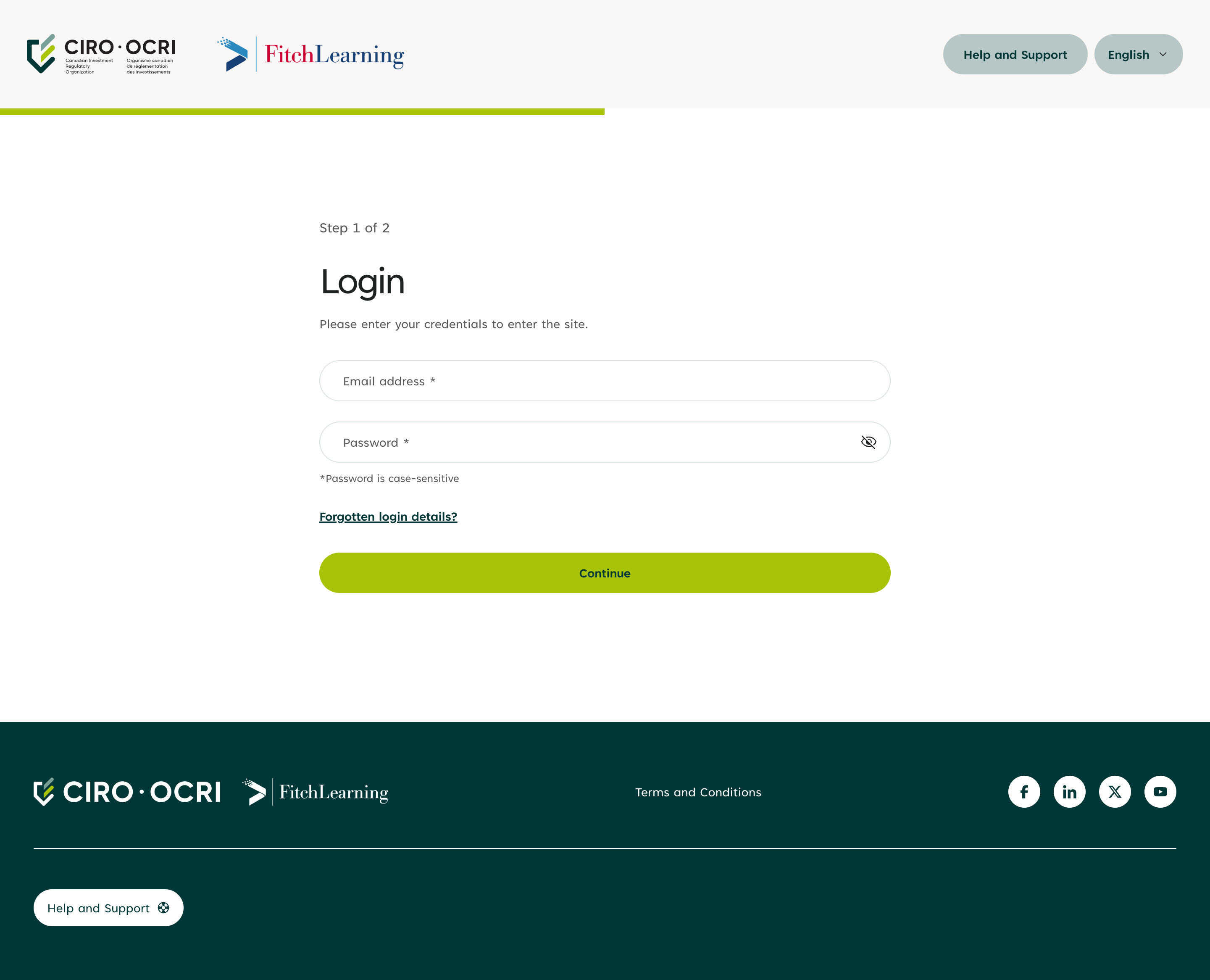
This is your home base from now on — booking, rescheduling, results all live here. Log in with those confirmation email credentials and you'll face the first real decision of this process: where do you want to take this exam?
Option A: Prometric Test Centre
Prometric runs testing centres across Canada. You pick a city, a date, a time slot. They provide the computer, the desk, the invigilator, the fluorescent lighting. You show up with your ID and nothing else.
This is the "just let me take the exam without thinking about my Wi-Fi" option.
Option B: Remote Proctoring
CIRO uses Prometric's ProProctor Live system. The "Live" part matters — a real person watches you through your webcam for the entire two hours. Not an AI. An actual human being, staring at your face, making sure you don't glance at your phone or let your eyes wander to that second monitor you forgot to unplug.
This is the "take a regulatory exam in sweatpants" option. More scheduling flexibility, no commute. But the tech setup is on you — and the consequences of getting it wrong are brutal (more on that in a second).
Here's the honest comparison:
| Test Centre | Remote | |
|---|---|---|
| Where | Prometric locations across Canada | Anywhere with stable internet |
| Who's watching | In-person invigilator | Live proctor via webcam + screen share + audio |
| ID check | Physical at the desk | Via webcam with a Readiness Agent |
| Equipment | Provided | Your computer, webcam, mic |
| Breaks | Centre-specific rules | Up to 15 min — but the clock keeps running |
| Tech risk | Close to zero | Entirely on you |
That last row is the one people underestimate. Per the Remote Exam Policy, if your Wi-Fi dies or your webcam fails because you didn't test it, CIRO records that as "absent" — which is a polite way of saying failed attempt. No do-over. You pay the $300 retake fee and try again.
Going Remote? Don't Wing the Setup.
Here's a scenario that plays out more often than it should: someone schedules their remote exam, doesn't bother testing their setup, and ten minutes before go-time discovers their webcam doesn't work with Prometric's software. Now they're panicking, Googling driver updates, and watching their exam slot evaporate.
The Remote Exam Policy says to test your system at least four days before your exam. That's not a suggestion — four days gives you enough runway to reschedule to a test centre if your tech isn't cooperating.
Your room setup matters too. Before the exam, a Readiness Agent scans your room via webcam. They're looking for:
- A quiet, private, well-lit space
- No second monitors
- No other people
- No notes, no textbooks, nothing on the walls behind you
- A clear desk
If your room fails the vibe check, you don't take the exam that day. And yes, that can count as an absent.
During the exam itself:
- Continuous live video, screen sharing, and audio monitoring — the whole time
- The proctor can ask you to show your desk, your surroundings, or your hands whenever they want
- If the proctor suspects a security violation, they can terminate your exam on the spot
- Unscheduled breaks: up to 15 minutes, but the timer does not pause. You're spending exam time, not break time.
ID requirements (remote and test centre):
- Valid government-issued photo ID with your signature
- Original only — no photocopies, no photos on your phone
- Name must match your Candidate Portal registration exactly
- Cannot be expired
No valid ID = no exam. The policy has zero flexibility here.
If things go sideways:
- Before the exam: Prometric's chat support — have your booking confirmation number ready
- During the exam: built-in live chat connects you to your proctor
Exam Day
Test centre: get there early. Bring your government-issued photo ID. Your phone, bag, notes — everything goes in a locker. The testing room is just you, a computer, and the knowledge that you paid $475 to be here.
Remote: launch ProProctor at least 15 minutes early. The Readiness Agent checks your ID, scans your environment. Once you're cleared, the proctor takes over and you're live.
Either way, it's the same exam: 110 questions, 120 minutes, all multiple choice, all scenario-based. A timer counts down in the corner. Each question presents a client situation — usually 50-100 words of setup — before giving you four answers that all sound defensible. You pick the best one and move on.
That's roughly 65 seconds per question, which feels generous until you're staring at a suitability scenario where a client's risk tolerance contradicts their investment request and you can't decide between B and C and the timer just hit 48 minutes remaining and you're on question 63.
Doing this cold on exam day is a terrible idea. Take at least one full-length timed mock beforehand — 110 questions, 2 hours, no pausing. The first time you feel that clock pushing you, you want it to be practice. EnCiro's Custom Mock Builder sets up exactly this: real question count, real timer, same format. It's the closest thing to a dress rehearsal you'll get.
For the full study strategy, How to Pass the CIRE Exam has the week-by-week plan.
After the Exam: Results and the Math Nobody Shows You
Per the Enrolment and Attempts Policy, results are provided immediately after you finish and appear in your Candidate Portal within 24 hours. You'll see a pass, fail, or absent result — no numeric score, no breakdown of what you got wrong. Just the verdict.
CIRO doesn't publish a fixed pass mark — they use psychometric standard setting where each exam version has its own passing score. Prep providers commonly estimate ~60%, but CIRO has explicitly said publishing a single number would be misleading. Either way, this is an entry-level competency exam, not a gladiator arena.
If you pass: your result goes to CIRO automatically. Your dealer member gets notified. You're done with this particular piece of bureaucracy.
If you fail: you can rebook through the Candidate Portal immediately. The retake fee is $300 CAD + tax — less than the initial enrollment.
Sounds manageable. But here's where the Enrolment and Attempts Policy gets real.
The Attempts Math
Your $475 buys a 12-month enrollment period with up to three attempts.
- Attempt 1: included in your $475
- Attempt 2: $300 retake
- Attempt 3: $300 retake
If you rack up three failed (or absent) results within a six-month window, a mandatory six-month cooling-off period kicks in. No rebooking. No re-enrolling. No "but I was so close." Six months of nothing, followed by a fresh $475 enrollment to start the cycle over.
Here's what that looks like in dollars:
| Cost | |
|---|---|
| Enrollment (attempt 1) | $475 |
| Retake (attempt 2) | $300 |
| Retake (attempt 3) | $300 |
| First enrollment period total | $1,075 + tax |
| 6-month cooling-off | $0 — but 6 months of your career |
| Re-enrollment (attempt 4) | $475 |
| Running total | $1,550 + tax |
$1,550 and six months before you even pass. And that's just the direct cost. If a job offer was contingent on CIRE, three failures probably means that offer is gone. If you're already at a firm, that's six months where you can't serve clients or earn commissions tied to your registration.
I'm not saying this to stress you out. The exam is designed for entry-level candidates, not veteran portfolio managers. But each attempt carries weight, and walking in underprepared is the most expensive mistake in this process.
If you've already failed once, the question isn't "should I study more" — it's "what specifically went wrong." EnCiro's Analytics breaks your performance down by element, so you can see whether it was KYC & Suitability, Securities & Products, or Ethics pulling your score down. Targeted study beats general review every time, especially when each retake costs $300.
(Want to understand what makes specific elements hard? Is the CIRE Hard? breaks it down.)
Rescheduling and Cancellation
Per the Enrolment and Attempts Policy:
- 36+ hours before your exam: reschedule for free via the Candidate Portal
- Under 36 hours: you're locked in. No-show = "absent" = failed attempt.
That 36-hour cutoff is hard. No exceptions for being sick, no "but my flight got cancelled." Miss the window, miss the exam, lose an attempt. It's worth putting a calendar reminder 48 hours before your scheduled date so you have buffer to decide.
One exception: if the exam fails due to technical or procedural issues that weren't your fault — Prometric's servers crash, the test centre loses power — CIRO may grant a replacement attempt at no charge. Key word: may. And if the tech failure was because you didn't run the system check on your end, that doesn't qualify.
Complaints go through Fitch Learning's support site within seven business days of the exam. Day eight? They won't look at it.
Every CIRE Fee in One Place
Because you shouldn't have to read three policy PDFs to find this:
| Item | Cost |
|---|---|
| First enrollment | $475 CAD + tax |
| Retake (2nd or 3rd attempt) | $300 CAD + tax |
| Rescheduling (36+ hours out) | Free |
| No-show / late cancellation | Attempt consumed — $300 for next |
| Refund (within 30 days) | Enrollment minus $75 admin fee |
| Refund (after 30 days) | Not available |
| Re-enrollment after cooling-off | $475 CAD + tax |
All prices before tax. Credit card only. No other payment methods.
Where to Get Help
Three organizations run different parts of this process, and none of them handle everything:
- Enrollment, portal issues, refunds: Fitch Learning Support
- Exam-day tech (before exam starts): Prometric Chat — have your confirmation number
- During a remote exam: built-in live chat in ProProctor connects you to your proctor
- Eligibility, policies, proficiency model: CIRO Proficiency Page
- Visual walkthroughs: CIRO's YouTube channel has portal walkthrough videos
When in doubt, start with Fitch Learning. They run the day-to-day.
The Whole Thing, Top to Bottom
Three steps. Two portals. One exam.
1. Enrollment Portal — create account, select CIRE, pay $475, attest eligibility. You get Candidate Portal credentials.
2. Candidate Portal — log in, pick remote or test centre, choose your date. If remote, test your setup four days early.
3. Exam day — verify your ID, sit 110 questions in 2 hours. Results in your portal within 24 hours.
The registration itself is painless once you know it's two portals, not one. The expensive part is what happens if you show up unprepared — $300 retakes, a potential six-month freeze, and the gnawing feeling that you could've avoided all of it.
If you're registered and staring at a calendar wondering how to actually prepare, EnCiro covers all 9 CIRE elements with 12,000+ practice questions, detailed explanations for every answer option, timed mock exams that mirror the real format, and analytics that tell you exactly which elements need work. The exam costs $475. A retake costs $300 and another month of your life. Good prep is cheaper than both.
FAQ
How do I register for the CIRE exam?
Registration runs through two separate Fitch Learning portals. You pay the $475 on the Enrollment Portal, receive login credentials by email, then schedule your sitting on a different site, the Candidate Portal. Different URLs and different logins. CIRO does not run registration itself; it is outsourced to Fitch Learning.
How much is the CIRE exam, including retakes?
$475 for a first attempt and $300 for each of attempts two and three, before tax. All attempts must fall inside a single enrolment window of up to 12 months. Failing three times within six months triggers a six-month wait before you can continue. A no-show or a late cancellation consumes an attempt, so the next sitting costs $300.
Can I get a refund on the CIRE exam fee?
CIRO's Fees, Payments and Refunds Policy, linked from its CIRE exam hub, sets the refund window and administration fee, and the policy itself is the only thing worth relying on before you pay. What matters structurally is that a refund cancels your whole enrolment period rather than one sitting, so you cannot partially back out. Rescheduling, including switching between remote and in-person, is a separate thing and is allowed until 36 hours before your slot.
Where can I sit the CIRE exam?
Two options, both booked from the Candidate Portal. A Prometric test centre, where you pick a city, date and time slot and bring only your ID. Or remote proctoring through Prometric ProProctor Live, where a live human invigilator watches via webcam for the full two hours. Remote requires a room scan by a Readiness Agent beforehand.
Do I need to complete a course before the CIRE?
No. The Fitch Learning Enrollment Portal states it plainly: preparatory courses are not required or provided. There is no CSC requirement, no CPH, and no mandatory coursework of any kind. You study however you choose and the exam assesses the competency, not the route you took to it.
What is the CIRE exam format?
110 multiple-choice questions in 2 hours. It is sat either at a Prometric test centre or under ProProctor Live remote invigilation. Personal calculators are not permitted; candidates get an on-screen Basic or Scientific calculator with no TVM keys.
Sources
- CIRO Proficiency Model — eligibility, exam requirements, proficiency framework
- CIRO CIRE Exam Hub — exam overview, enrollment links, policy documents (Enrolment & Attempts, Fees & Refunds, Remote Exam policies all linked from here)
- Fitch Learning Enrollment Portal — exam enrollment and payment
- Fitch Learning Candidate Portal — exam scheduling and results
- CIRO New Candidates Guide — onboarding and eligibility
- Prometric Remote Exam Experience — ProProctor Live system requirements and setup